After a rough few years for healthcare investment, the exits market is opening up and healthcare admin, AI and data are catching investor’s eyes.

After its post-Covid spike in 2020 and 2022, healthcare was one of the hardest hit sectors when the market cooled, with corporate-backed startup investment halving in dollar terms between 2021 and 2023, and with deal flow falling roughly 40% in that same timeframe.
Since that nadir, investment has been slowly crawling back, with deal flow returning to pre-2021 levels, even if dollars invested haven’t yet, according to GCV data. In 2026, investment in the sector is expected to continue to rebound as exits return.
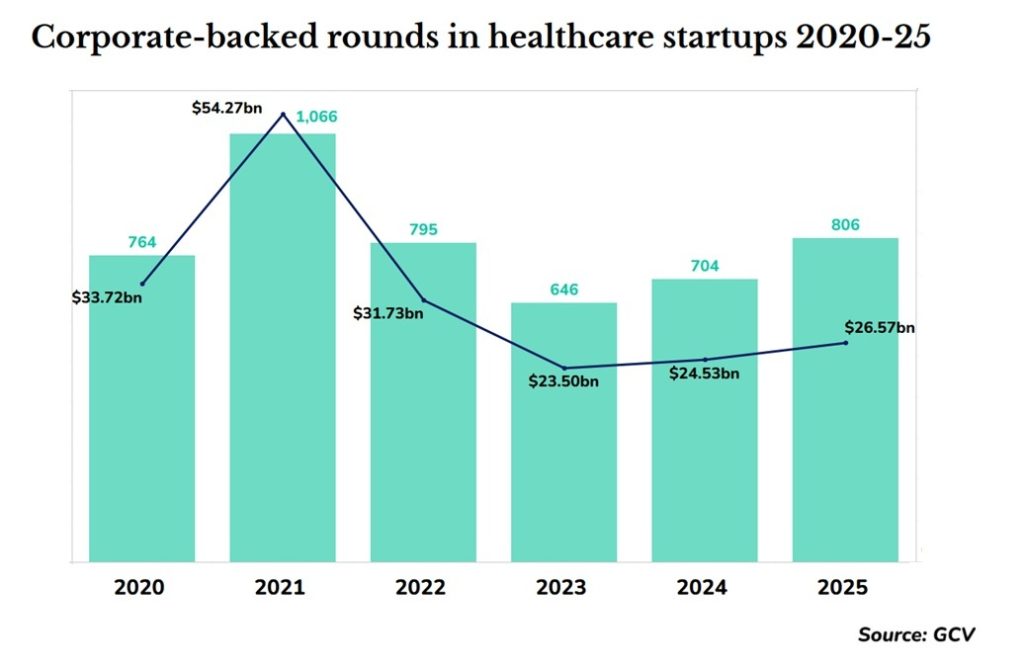
Between 2024 and 2025 up to mid-December, pharmaceuticals saw a small year-on-year deal flow decrease of 3%, while care provision and on demand services also saw a 13% decrease, according to GCV data. Where there were big gains was in medical devices and diagnostics with 38%, and healthcare IT and administration with 60%.

Investing in healthcare and looking for networking opportunities? The GCV Healthcare council convenes regular in-person and online events.
Find out more about the council here
Early-stage money in pharmaceuticals is still hard for startups to come by, but elsewhere in the space, corporate investors are increasingly keen to put capital behind new data and AI-centric technologies that reduce risk and accelerate near-term revenue visibility.
Money needed at earlier stage
The healthcare VC space has been suffering from a lack of capital at the early stage – many of the startups that were well-funded in the boom cycle failed to produce clinical proofs over the next couple of years and that meant much of the VC money went to later, closer-to-market technologies as LPs were wary of markdowns and long hold times.
“We were actually hoping to see more institutional VC money being invested in earlier-stage preclinical or platform biotechnology companies, and that hasn’t surfaced as of yet. Most of the institutional VC money is still going to later-stage assets or clinical pipelines rather than earlier-stage, high-science, cutting-edge platforms,” says Hakan Goker, managing director at M Ventures.
The corporate VCs, which benefit from more patient capital and a more strategic lens, can make more bets earlier on, but startups still need a critical mass of institutional investors to have a strong a cap table.
Funding and exits
Like with other sectors the VC industry, healthcare is starting to benefit from more startups being acquired or or listing on the stock market.
A major M&A driver for pharmaceutical corporates over the next few years will be the loss of exclusivity on some of their biggest moneymaking drugs. Historically high losses are expected from a concentration of patent lapses over the next three years.
On the line are potentially tens of billions of dollars in reduced revenue as generics and biosimilars will be entering the market, resulting in rapid and significant losses of revenue for corporates once patents expire.
As a result, pharmaceutical companies are scrambling to find revenue streams to offset those losses, and are expected to participate more aggressively in M&As, potentially providing improved exit opportunities for startups, even at a premium.
AI
It’s been the year of AI, and healthcare has not been immune from it, but there have been growing pains. The prospects for applications in drug discovery have received perhaps the most excitement in the public eye, but despite promising signs, AI is far from a silver bullet at this point.
“In my personal view, the potential offerings of AI in drug discovery and development are still too early to tell. We haven’t yet seen many AI approaches validated clinically where you can confidently state that the system provided a significant delta to the path from discovery to positive clinical results,” says Goker.
While it is useful in the earliest stages – finding the chemical compounds that comprise a drug – AI startups haven’t yet shown they can alleviate the “chug-along train” of drug development – the arduous process of validation and approval to get them to market.
Where it is set to make an even bigger impact is in better usage of data during trials and the ability to optimise the process such that fewer patients need to take a placebo during trials, lowering the costs and streamlining the process. At this point, though, the field is wide open without many clear winners.
Across the rest of healthtech, particularly in administrative and healthcare system workflow, AI is showing it can have a big impact in leveraging the data healthcare systems have, redesigning often clunky IT infrastructure, and modelling and auditing.
There will be a push towards validating AI-based tech in clinical settings in 2026, and away from more speculative tech without near-term paths to value. Startups that can demonstrate clear, near-term ROI, defensible data moats and regulatory readiness will be rewarded.
Tech to watch
On the therapeutic side, oncology is always a strong area of growth, and investors are seeing immunology coming back in a big way, particularly precision immunology and targeted solutions that can treat a condition without wider effects on the immune system.
A fast-moving growth area will be in fertility, says Goker, with interest increasing as fertility rates drop at a faster rate, and at a younger age, in developing countries across the West and Asia.
“Historically, we have been very active in it as the pharma group and as an investor, and recently we’re seeing that quite a lot of the VCs are pretty interested to play in the space, which is a good change,” says Goker.
Areas like RNA therapies for treatments other than vaccines continue to be difficult logistically and may consequently struggle to see a huge amount of investment, but then other areas like metabolic treatments and GLP-1 drugs – particularly those focuses not just on reducing appetite but also increasing metabolism – will attract investor interest.
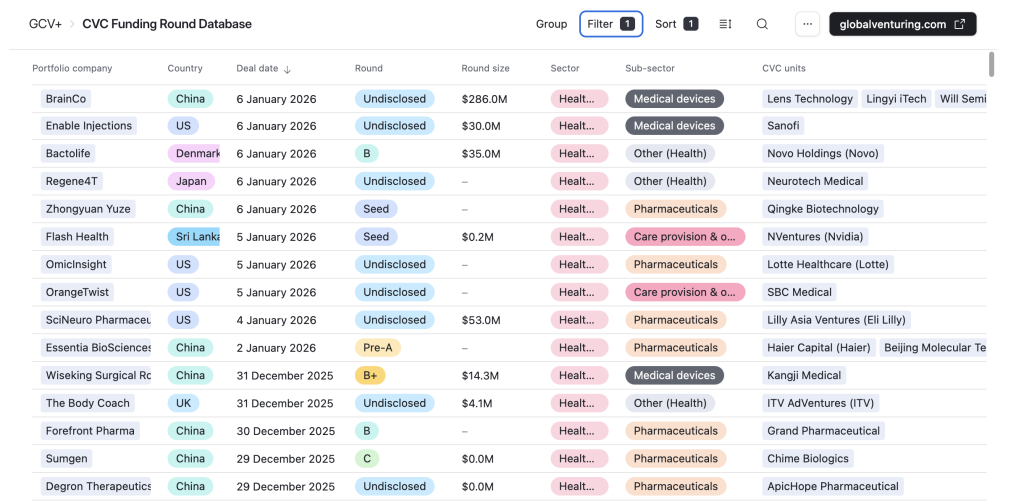
See all the recent corporate-backed healthcare investments
in the CVC Funding Round Database

Fernando Moncada Rivera
Fernando Moncada Rivera is a reporter at Global Corporate Venturing and also host of the CVC Unplugged podcast.