Corporate VC investors believe conflicts like Iran will help cleantech startups, but resiliency and sovereignty are bigger factors than energy prices.
War in the Middle East will likely boost long-term cleantech investment, but the impetus behind it will be resiliency rather than a rise in fossil fuel prices, say corporate VCs in the energy industry.
Crispin Leick (below), managing director of German utility EnBW’s corporate venture arm, sees the Iran conflict as one of three recent shocks to the energy industry, following the 2020 coronavirus outbreak and the war in Ukraine, which began in 2022.

In each case, he says, the long-term trends of electrification, digitalisation and decentralisation in the sector have been strengthened.
“Whenever a crisis hits, the underlying strong megatrends not questioned, they are always reinforced, again and again,” he adds.
The effects of those trends are being seen in areas like heating, which is shifting from gas to electric, and the batteries now being fitted to new renewable energy projects as a matter of course.
As recently as three years ago, these processes would be touted as decarbonisation measures, but Leick frames them as being about energy resiliency. He also says that the recent rise in oil and gas prices are less of a factor than some believe.
Crude oil prices were below $60 in early February but rose to over $100 per barrel following US and Israeli airstrikes on Iran, which retaliated by bombing the liquid natural gas infrastructure of neighbouring Qatar and blockading the Strait of Hormuz, through which some 20% of the world’s oil supply is exported.
Crude remains at about $96 at the time of writing, but the futures market does not expect that increase to last. Prices are projected to steadily decrease over the next five years, when the turmoil has hopefully been reduced if not eliminated.
“There’s always this narrative that oil prices will be high and they will stay high and yes, the situation is there unresolved,” Leick says. “But what happens with this is people look for new solutions – new pipelines, different connections. They will try to circumvent this bottleneck somehow.
“And if this crisis gets resolved and there is a negotiated solution, it will be very interesting to see what happens to energy prices. Because when you look at the longer-term future market and the future prices for gas and oil, they’re in strong backwardation,” adds Leick, referring to a market situation where current prices for a commodity are much higher than prices for future delivery, indicating an expectation that supplies will improve.

Frederico Gonçalves (left), head of corporate venture capital for energy utility EDP, agrees. “In the short term, things will not change,” he says. “The pace is the pace.
“Even at EDP, as a developer of renewable energy, we are not accelerating investments in infrastructure. It doesn’t impact [things] in the short term. But what I believe is that there are lots of sectors that were adopting energy tech solutions more slowly, and these will accelerate.”
Those sectors include industrial processes, which are increasingly using electricity to generate the large amount of heat they need, and transport, which is still moving from petroleum to electric vehicles (EVs). Gonçalves argues that globally, those two areas will be responsible for even more growth in demand than data centre infrastructure.
In a wider sense, the move away from fossil fuel is reflected in which startups are being funded.
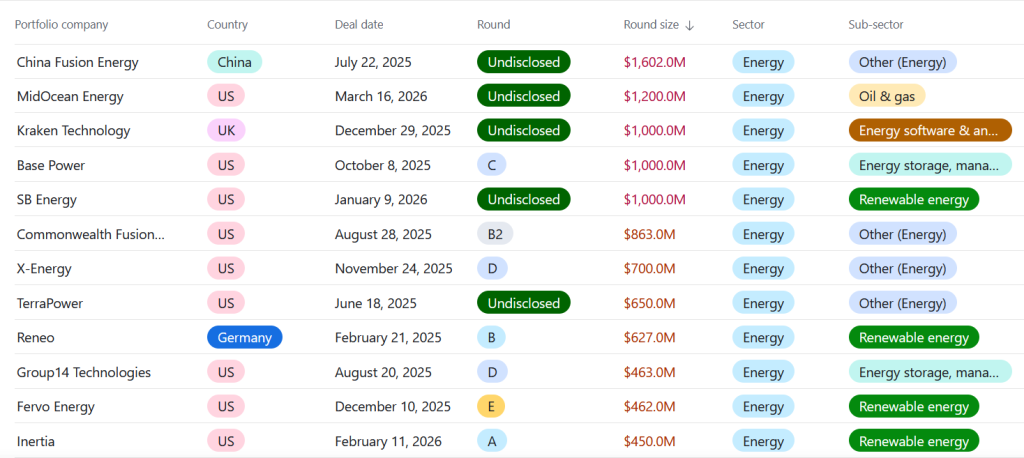
Nuclear technology and renewable energy startups dominate the largest energy tech funding rounds since the start of 2025 (see below) and X-energy, a modular reactor developer backed by several corporates, raised over $1bn in its initial public offering last month. Anecdotally, the Iran conflict is already boosting consumer sentiment around switching away from fossil fuels.
See the largest corporate-backed energy startup deals on the CVC Funding Round Database:
It isn’t just a matter of money flowing from ‘dirty’ fuel sources to renewables, however. Sarah Applebaum, partner at hard tech-focused VC firm Pangaea Ventures, argues that the overall outlook is more complicated.
“Any macroeconomic event that signals potential for rising interest rates, inflation and rising costs is a net negative for climate-related investments, whether it’s capital intensity, a need for project finance or steel on the ground, because that makes some of these projects less economically viable,” she says.
“That is a challenge, and uncertainty in general freezes the movement of capital. We’ve seen that with previous geopolitical shocks, and so it might lead to a bit of a slowdown.”

Sovereignty may well be a bigger factor in any shift, says Applebaum (right).
Growth in renewables is increasingly being cited as a way for countries to generate their own energy domestically and lower their dependency on oil and gas imports. In the past, that meant not relying on the governments of fossil fuel-rich countries such as Russia or Saudi Arabia; now, the Hormuz blockade is explicitly tying the issue to availability.
“The conflict in Iran is highlighting supply chain risks in a way I don’t think they’ve been highlighted in a while, which ties into national sovereignty and security for many nations and a renewed investment landscape,” Applebaum says.
“I think there is going to be additional capital available for energy infrastructure, sovereignty and resiliency there. Some of that will flow into renewables, alternative fuels, maybe some more investment in nuclear as a result, recognising how oil resources are not distributed evenly.”
Geopolitics may play a part, but the largest factor in that change will likely be advances in technology.
Solar panel prices have plummeted in the last decade on the back of advances in manufacturing and efficiency to make solar power cheaper than hydro, nuclear and geothermal as well as coal. Wind energy has largely benefitted from similar long-term trends, despite prices rising in the short term.
The sector isn’t plain sailing: investment in technology areas like hydrogen have dropped in the past year as the regulatory environment has become less friendly, and the commercialisation of modular nuclear reactors, let alone fusion energy, remains years away.
Despite that, startups are making progress in nuclear as well as in technologies that can improve the batteries needed for grid-scale energy storage and EVs, and in technologies that can make energy infrastructure more resilient and power distribution more efficient.
As renewable project developers like SB Energy and geothermal-focused Fervo raise huge amounts of money themselves, events like the Iran war will only accelerate the growth of cleantech and alternative energy systems. The oil crisis of the 1970s was a factor in the birth of the modern renewables movement, but the industry has now moved far beyond that point.
“I think it [will have] a lasting effect, because people will not switch back,” Leick says. “The current crisis is completely different from the old crisis in the 1970s because there are commercially great products available as alternatives.
“You can decide to drive electric for the next step – the products are there, the offerings are there. In the ‘70s, you basically had to stop using your car in order to avoid the problem. Now you can do something about it.”

Robert Lavine
Robert Lavine is special features editor for Global Venturing.