Boston Scientific is taking a leaf from the IT sector in using corporate venture deals for acqui-hire and product optionality.
New York-listed medical device company Boston Scientific under senior vice president Charlie Attlan has been a strategic corporate venturer and has acquired at least a handful companies from its venture portfolio, including Devoro Medical, Preventice Solutions, Farapulse, Cryterion Medical and NxThera. Another novel corporate development deal is now on the cards taking a leaf from companies in the computer technology sector.
Boston Scientific has invested $1.5bn for a 34% equity stake in MiRus. As part of the investment agreement, Boston Scientific also received an exclusive option to acquire the MiRus Transcatheter Aortic Valve Replacement (TAVR) business by making additional aggregate cash payments of up to $3bn.
If Boston Scientific exercises the option, MiRus will have the right to receive additional payments based on net sales of the Siegel TAVR valve over a specified period and Boston Scientific will also have an exclusive option to acquire mitral and tricuspid replacement valve assets from MiRus for an additional payment.
The Siegel technology is built on a proprietary rhenium alloy and is the first nickel-free, balloon-expandable TAVR valve intended to restore function and normal blood flow of severely narrowed aortic valves. It was the first new alloy approved for use in medical device implants in the previous 40 years.
It is a big commitment but Boston Scientific and MiRus have past form. Jay Yadav set up MiRus more than a decade ago having seen his former companies successfully exit, including CardioMEMS (acquired by St. Jude Medical); Angioguard (acquired by Johnson & Johnson); and Smart Therapeutics (acquired by Boston Scientific).
By backing MiRus as a holding company, therefore, Boston Scientific benefits from potentially buying the technology and as a shareholder gaining a window into future developments by Yadav while avoiding anti-trust concerns.

Come join the conversation about how CVC is evolving at the GCV Symposium in London on 23-24 June
This follows the ‘acqui-hire’ playbook of Nvidia among other tech groups, which pay for talent and products while leaving the main business still functioning. In a landmark transaction at the end of last year, Nvidia entered a $20bn licensing and acqui-hire agreement with AI chip startup Groq. Rather than fully acquiring the company, the cash deal secures a perpetual license to Groq’s patent portfolio and software stack, while bringing on Groq’s leadership and core engineering team.
Boston Scientific’s agreement is a good win for MiRus’ backers, including Mammoth, which led the $70m series D round at a post-money valuation to $355m.
It is a boost to medtech as an investment category after a few relatively slow years following the highs of 2021, when annual deal counts reached 635 and quarterly investment routinely exceeded $4 billion. In medtech, venture funding totalled $2.5bn across 79 rounds in the first three months of the year, investment bank JP Morgan said using DealForma data.
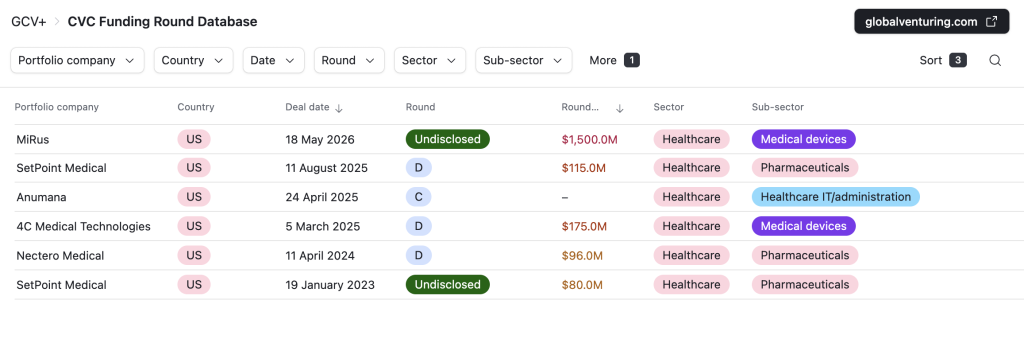
Recent startup funding rounds backed by Boston Scientific
See all the corporate-backed startup deals in the CVC Funding Round Database