March may not have had the fireworks of an xAI-SpaceX merger, but longer-term growth now looks locked in.
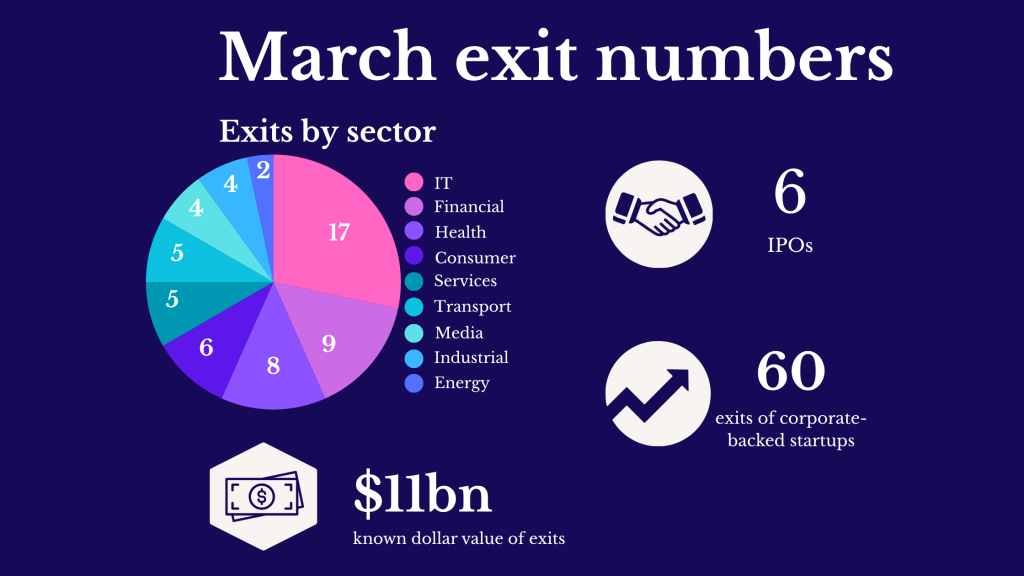
March was always going to be a quieter month for exits than February, when generative AI developer xAI was merged into SpaceX, but with $11bn disclosed from 60 exits, investors can benefit from an exit market that appears to be holding relatively steady following the covid-19 market downturn.

In comparison, March 2025 had a much higher disclosed exit value of $46bn from 56 exits, though $32bn of that amount was due to Alphabet’s acquisition of cloud security software provider Wiz, which counted SoftBank as an investor. Take out that deal and the year-on-year growth in exits begins to look more clear.

March 2024, for instance, only saw $3bn from 27 exits, a clear indication that the venture recovery period was yet to arrive. Track the exits market since that point and the trajectory has largely remained upward, with some peaks but no major dips. All of this is a positive sign for corporate investors seeking returns.


Of the exits recorded in March where the value was disclosed, the highest number, eight, were between $100m to $1bn, seven were below $100m in value and five were above $1bn – the highest monthly figure so far in 2026.

The total value of exits under $1bn was $3bn, a fall from the value generated by similar deals in February and the lowest it has been since June 2025.

Four of the five $1bn-plus exits were acquisitions, equally split between the US and UK, with only one IPO in the mix – Japan’s PayPay, a provider of mobile investment and asset management services that counted SoftBank and LY Corporation among its backers, closed its IPO at $1.1bn.

The largest exit for the month was Mastercard’s $1.8bn acquisition of UK’s BVNK, a stablecoin-based payment technology provider that included Citibank, Visa and Coinbase in its list of corporate investors. This was followed by Gilead Sciences’ $1.6bn acquisition of immunology treatment biotech developer Ouro Medicines. Corporate investors seeing a return from that deal included GSK and UPMC Enterprises.

The third largest exit was the $1.5bn acquisition of independent music publisher Kobalt, which had JPMorganChase, Hearst and Alphabet in its list of corporate investors, by Primary Wave.

As has been the trend over the past two years, the IT sector saw the highest exits with 17, while the financial sector took second place with around half the number of exits at nine, followed closely by healthcare at eight.

Both the IT and financial sectors saw fewer exits in March compared to the previous month, while the number of transport exits more than doubled, nearly matching the high of September 2025. With a $1bn-plus exit each, the consumer and media sectors also saw double the number of exits last month – six and four respectively.

The majority of March’s exits pie was comprised of 49 acquisitions – a touch higher than the 48 recorded in March 2025 but slightly lower than February’s count of 54.

China led the IPO charge in March with five out of the six listings on record. Seeya Technology’s $292.4m listing was the largest, followed by Guangdong Huayan Robotics’ $201.8m listing. They counted the likes of Xiaomi, Goertek, Wuhan Jingce Electronic Group, China Merchants Group and Donghai among their corporate backers.

The six IPOs in March 2026 were three times higher than the two IPOs that took place in March 2025, a period that was dealing with an uncertain public market due to the tariffs being levied by US President Donald Trump. Given the ongoing war in Iran, it is unclear how the stock market will react in the coming months and how that influences the companies that are ready to go public.

March was also the first month this year to see three exits via a special purpose acquisition company, or SPAC, matching the high of November 2025.

The US remains the biggest exit market by far, with nearly half of all corporate-backed startup exits globally at 29. China and UK were a distant second with five, followed by France, Germany, India and Japan with four.

Oishani Mitra

Oishani Mitra is the content manager for Global Corporate Venturing.