The Dutch company, dubbed the "Intel of quantum computing" is targeting a 100x breakthrough in the number of qubits on a quantum processor.
The Dutch quantum hardware company has raised one of the largest private funding rounds in the sector to date, underscoring Europe’s push to build an industrial base in quantum computing.
QuantWare said on Tuesday it had secured $178m in a series B round, with new investors including Intel Capital and In-Q-Tel. Existing backers such as FORWARD.one and Invest-NL also participated.
The Delft-based group is attracting interest because it is developing technology that could break through one of the biggest bottlenecks in quantum computing: scaling up the hardware. For around a decade the quantum computing sector has been struggling to move beyond processors with around 100 qubits, or quantum bits. IBM’s quantum roadmap, for example, involves reaching a 120-qubit process by 2028.
QuantWare, however, last December unveiled VIO-40K, a 3D architecture enabling 10,000-qubit superconducting processors by 2028 — around 100 times larger than current state-of-the-art. While such targets remain aspirational, the focus on manufacturability reflects a broader shift in the industry from laboratory breakthroughs to engineering challenges.
“In superconducting quantum computing, scale is increasingly constrained by routing, packaging, and manufacturability — not just qubit design,” said Kike Miralles, investment director at Intel Capital. “QuantWare recognised that early and built VIO to address it.”
QuantWare, a spin-out from QuTech and the Delft University of Technology, plans to use the funding to scale production through what it calls “KiloFab”, a dedicated fabrication facility designed to increase capacity twentyfold.
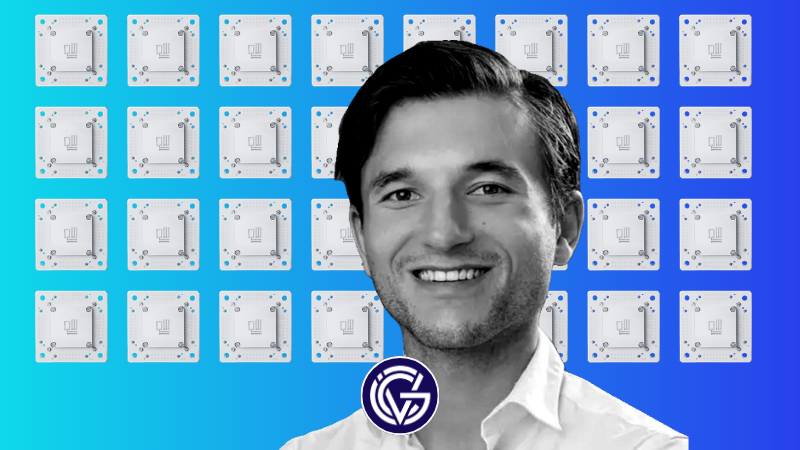
“The promise of quantum computing… can only happen once it can be manufactured and deployed at scale,” said chief executive Matt Rijlaarsdam (pictured, above). “That is exactly what we are building.”
The raise comes as Europe seeks to close a perceived gap with the US and China in quantum computing, an emerging technology that promises to tackle complex problems beyond the reach of classical machines. While the region has long been strong in academic research, translating that into industrial-scale hardware has proved more challenging.
From lab to key quantum sector supplier
Riljaarsdam said QuantWare’s origins at the QuTech quantum computing institute in Delft gave it a head start seeking solutions for scaling up quantum processors. QuantWare cofounder Alessandro Bruno led fabrication of the quantum chips at the lab.
“There’s a tremendous ecosystem in Delft, specifically around QuTech,” said Rijlaarsdam. “I don’t think we could have built this anywhere else, because the expertise was there.”
“Ten years ago we were making some of the largest quantum processors in the world, on the order of 50 qubit sizes. When you get to those sizes, you run into all kinds of scaling bottlenecks. This is the threshold that the industry stuck on for decades,” he said. QuantWare’s solution was to make modules with qubits in them, that could be attached together to create very large, very dense quantum processors.
QuantWare focuses on superconducting qubits — as opposed to other approaches such as trapped ions, photonics, and semiconductor spin qubits — because these are the most powerful for compute power said Rijlaarsdam. However, the architecture is open to being used with any type of superconducting qubit.
QuantWare’s model differs from some competitors in that it aims to serve as a supplier to the wider quantum computing ecosystem, rather than building full-stack quantum computers.
“Our mission is to get the entire industry to scale using VIO. And so we offer it via what’s called a quantum open architecture model. We offer it to players that make their own qubit designs, and even to players that make their own qubit chips,” said Rijlaarsdam.
The company has so far shipped to more than 50 customers across 20 countries, including research institutes and technology groups.
That positioning aligns with a growing recognition that the quantum sector will depend on specialised supply chains, much like the semiconductor industry. “The company is poised to play a key role in shaping the global quantum supply chain,” said J.D. Englehart, senior investment director at In-Q-Tel.
Rijlaarsdam said that he welcomes the backing of corporate investors like Intel as they share QuantWare’s vision for the development of the quantum computing industry. “They understand this vision of being able to with the right technology build up this important position in the value chain,” he said.
For Intel, the investment fits into a broader, if measured, engagement with quantum technologies. The US chipmaker has backed a number of quantum hardware and enabling technology companies over the past decade, while also pursuing in-house research into cryogenic control systems and qubit architectures. Its approach has been less high-profile than some rivals but reflects a long-term view of quantum as an extension of advanced computing infrastructure.
Although it did not invest in this round, Nvidia is also partnering with QuantWare, Rijlaarsdam said, and the company is open to working with companies across the classical semiconductor space.
Europe as a quantum hub?
Quantum is an area of tech where Europe has stepped up efforts to build its own champions. Initiatives such as the EU’s Quantum Flagship programme and national funding schemes in the Netherlands, Germany and France have channelled billions into research and early-stage companies. Startups including IQM Quantum Computers and Pasqal have also attracted significant funding as the region attempts to retain talent and intellectual property.
Rijlaarsdam said the QuantWare’s oversubscribed funding rounds shows that European tech companies aren’t just good at the initial science, but can also get scale-up capital from global funders.
“I think with this round, we’ve shown that if you’re building a company that is making excellent progress, that has the right technology, the right team and the right customers, then you can also attract global capital,” he said.
The decision to build the fabrication facility in the Netherlands is also significant, and something that was important for backers such as Invest-NL Deep Tech Fund and InnovationQuarter Capital, the investment arm of the regional development agency for South Holland.
“With this round, also the investors from the European side, the Dutch side, they share that vision of building a very large company in the Netherlands,” said Rijlaarsdam.
Investors say the next phase will hinge less on theoretical advances and more on execution. “Building a global compute hardware company requires immense ambition,” said Robin van Boxsel of FORWARD.one. “With their VIO technology, they hold the key to leading the high-growth quantum industry.”
Despite the influx of capital, commercial applications of quantum computing remain limited, and timelines for practical advantage are still debated. But the scale of recent funding rounds suggests confidence that the industry is moving towards a more mature phase.
QuantWare’s bet is that this transition will be defined not by a single breakthrough, but by the ability to manufacture complex systems reliably and at scale — an area where Europe has historically struggled to compete.

Maija Palmer
Maija Palmer is editor of Global Venturing and puts together the weekly email newsletter (sign up here for free).