In the latest edition of Blueprint, GCV editor Maija Palmer thinks IAG's corporate venturing model is one that other CVCs should explore further.

One of the ways that corporate venture capital is becoming more sophisticated, is that practitioners are becoming skilled at using different approaches and tools for specific problems they are looking to solve.
Take the International Airlines Group which has run a CVC programme for a decade now. I caught up last week with Matt Ridley, director of sustainability and innovation at Oneworld Alliance, and Raza Ali, managing partner at IAGi Ventures, who will be speaking at the GCV Symposium in June and was impressed with the way they have tackled this.
Like many corporate VCs IAG Ventures was looking to tackle several different types of issues with very different time horizons. On the one hand, business units wanted technologies that would solve immediate operational problems — digital solutions to help bookings systems, baggage handling and customer experiences run more smoothly. On the other hand, the airline group needed to grapple with the enormous, industry-wide issue of finding a path to sustainable aviation fuel to meet climate change targets.
The aviation fuel problem was not something that Ridley felt a single airline could handle on its own. The deep, PhD-level expertise needed to evaluate the chemistries of different feedstock alternatives is not something that a lean corporate investor team can hire for. Ridley was clear that an industry-wide approach was needed, and that a partner with specialism in deep tech investment would be needed. What followed was a partnership between the airlines in the Oneworld Alliance and Breakthrough Energy Ventures, the VC founded by Bill Gates, creating a $150m SAF fund.
The process of getting several airlines, some of which had little previous VC experience, into a joint fund — and making that interesting to Gates’ investment vehicle — is a story that is worth hearing Ridley recount.
But what is equally interesting is how comfortably that fund-of-funds strategy now sits alongside the direct venture focus led by Ali at IAG. It has, essentially, freed Ali to shake up and focus IAG’s direct startup investment strategy on areas with immediate, strategic, balance sheet impact on the airline. Investments in satellites and AI, for example, are on the centre of his radar. Meanwhile, though the running of the fund is in the hands of Breakthrough Energy Ventures, there is active involvement and two-way insights between them and IAG. It isn’t a “pay in your capital and forget it for 12 years” scenario.
It is a model that has potential for many other industry sectors that are facing collective foundational challenges. Ridley and Ali will be sharing all their insights on this at the GCV Symposium, and it is a session well worth marking in the calendar.
Ahead of the Symposium we will be running a webinar on May 20 looking at the process of setting up a CVC unit from scratch. With interest in CVC creation still strong globally, we wanted to provide those who might still be in the planning phases with helpful frameworks and guides. Sign up here for the session — and please pass this on to anyone you know who might find this helpful.
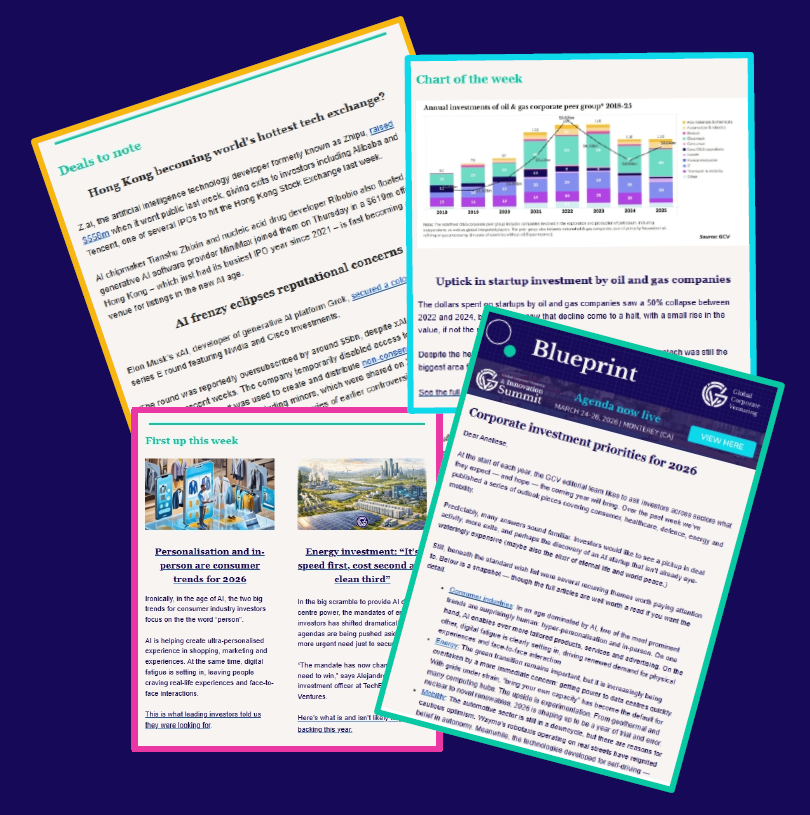
This editor’s note was first published in GCV’s Blueprint newsletter, which tracks corporate venture news, key deals, new funds best practice and jobs.
Want to get Blueprint directly in your inbox every Monday? Sign up for free here.

Maija Palmer
Maija Palmer is editor of Global Venturing and puts together the weekly email newsletter (sign up here for free).