When energy tech VC firm Future Energy Ventures spun off from E.ON, it had to learn how to mix the needs of corporate and financial investors.

Energy tech-focused, corporate-backed venture firm Future Energy Ventures (FEV) just closed its first multi-LP fund at €235m ($272m) after three years of fundraising. But if co-founder and managing director Jan Lozek could go back and start again, there’s one thing he would change.
“If I regret one thing, I would say we did not spend too much time on product structuring and product testing,” he says.
FEV was originally formed by energy utility E.ON, the sole backer for its first fund, but after it was spun off and it began recruiting more limited partners (LPs) for its Fund II, Lozek had to begin thinking of the fund as a product he was offering to potential investors.
“Maybe that was not part of our DNA or thinking,” he adds. “Generally, you should always start with the customer, but as we were newbies at the time we started, we just missed out taking a little bit more time and being a bit more mindful. Because if you have the right product for your customers, it’s easier to raise funds.”
The fund’s final LP list combines energy companies, industrial-focused conglomerates and at least one public transport operator, as well as institutional investors like the European Investment Fund (which co-anchored it with E.ON) and development bank fund KFW Capital. When a fund has both corporate and institutional backers, it needs to be aligned to what both are potentially looking for.
“Corporate investors wanted to have access, meet [startup] teams, be in close proximity to their customers. Or… they just wanted to see new things”
“Corporate investors wanted to have access, meet [startup] teams, be in close proximity to their customers,” Lozek says. “Or… they just wanted to see new things.
“Financial investors are more: ‘I need to allocate this type of capital, it should have this type of risk structure, it should be in these and these locations,’ and that’s not always the same. It needs to have some alignment.”
Going from answering to a single strategic LP like E.ON to dealing with many is also a step-change. One advantage of having 20 backers instead of one is that the fund is not as tied to just one LP’s strategic focus, Lozek says, and there is also the opportunity to structure more amenable terms.
“You may be able to also balance out your ideas, your thinking and the [investment] process, instead of just having a one-to-one relationship,” he adds. “With governance, you’re a bit less impacted if investors change strategy. For example, if you have a large corporate investor, they can change the strategy tomorrow and you are out: they bring your vehicle to the market, sell it, and then you look for a new job!
“That’s a disadvantage. But the advantage is that with a larger corporate player or a one-investor type of structure, it’s a pretty fast-track process. You align on strategy, what you want to invest into and the structure, and there you go. It’s a much leaner, more efficient process.”
Seeking LPs with expertise and infrastructure access
While FEV was seeking out LPs, Lozek says the firm had a firm idea of the kind of backers it wanted. They didn’t have to be like E.ON, an energy utility with 50 million customers and more than 2 million kilometres of grid distribution, but it did specifically seek out backers that could bring expertise in areas close to the energy transition.
“Take Zorlu, from Turkey, as an example,” he says. “They produce electricity meters, electric vehicle charging stations, and they’re running infrastructure in that space.”
Access to that type of company gives FEV insights on how the energy transition is affecting that sector, Lozek says. It can help the firm understand what kinds of technology is required and what can realistically be scaled up soon.
“Another investor, (Hong Kong-based) MTR, is totally different,” he adds. “They are a public transportation and real estate business operator, and they give us more access to the Asian market and to the real estate asset class: where to innovate, what’s hot, what is needed and so on; and on the transportation side, what type of electrification solutions are needed right now, what is more long term and what is more short or mid-term.”
An interesting quirk in FEV’s Fund II is that €30m, provided by Italian development bank Cassa Depositi e Prestiti (CDP), will be reserved for investment in Italian startups. CDP was interested in committing to the fund, Lozek says, but its mandate states it can only invest in domestic companies, which is why the capital has to fund startups through a separate vehicle to the main FEV fund. And he is excited about Italy’s startup sector in general.
“We see the Italian market growing,” he says. “There are more and more founders, and they are also trying to relocate founders from other geographies.”
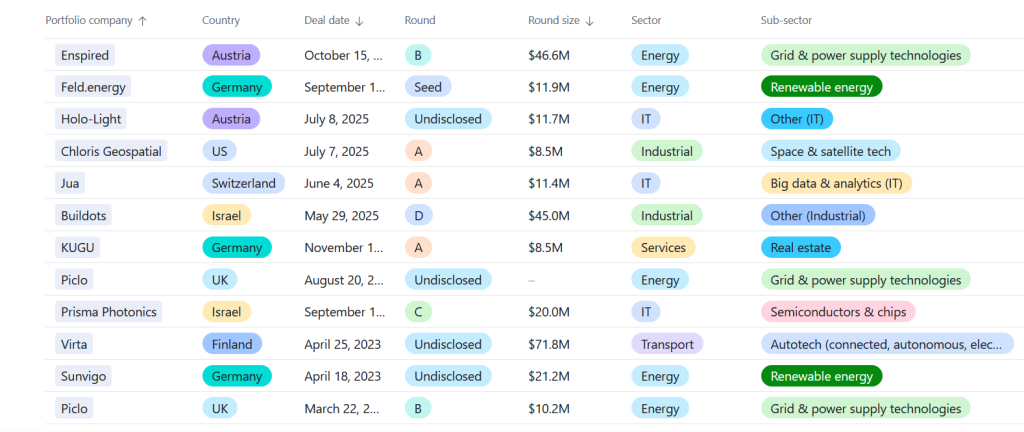
Those include the Italian founders of Chloris Geospatial, a forest carbon data provider backed by FEV’s Fund II. The company was formed and is still based in Boston, in the US, but has part of its operations in Italy where costs are lower and there is access to financing from local banks as well as to European utilities.
Emerging investment themes: grid, data centres and ‘energy-under-water’
Lozek says grid technology is playing a significant part in Italy’s energy technology ecosystem, along with satellite technology (like Chloris’s). An emerging area could be ’energy-under-water’ startups like Sizable Energy, an Italian company that just closed series A funding for its underwater pumped hydro storage system.
Globally, Lozek expects grid tech to be the big growth area in the next year or two, as startups apply artificial intelligence to the problem of helping grids manage the energy needs of data centres.
“AI-based energy optimisation and energy management solutions could be trending, but it could be more optimisation of industrial sites. That is also quite interesting, especially as we see a lot of different AI applications there,” he says.
“[But] the grid system will be the one of the challenges remaining. We see a couple of topics here which are relevant for the US, like ageing grids. But much more important is how and where to locate data centres, how to connect them to the grid and how to manage and balance energy. That is a huge issue in both the US and Europe.”