More corporations are becoming early customers of startups rather than investing in them. Here are the benefits and how to do it well.

Venture clienting is the shiny new part in the corporate innovation toolkit. Nearly half of corporates with venturing activity now run some form of ‘startup-as a-supplier’ programme, moving straight to pilots and commercial contracts rather than starting with equity investment.
On paper, it is the perfect answer to today’s pressures: faster payback, technologies that are closer to the core business and less balance sheet risk. But, in practice, venture clienting can turn into innovation theatre, without changing how the business runs, if it is not done in a systematic way that measures success.
In Global Corporate Venturing’s Next Wave webinar Venture clienting: A smarter path to innovation – or a strategic distraction, with representatives from Maersk, Holcim and Progreso X, one theme stood out: the best venture clienting programmes behave less like a showcase for startups and more like a problem-solving engine for the business.
Successful venture clienting models start with specific pain points, tie every pilot to strategy and revenue growth, and are designed for scale from day one. The result: Maersk scales more than 60% of its pilots with startups; Holcim has run around 200 pilots in more than 10 countries; Progreso X has turned a pilot into a new client offering that helps it win new business.
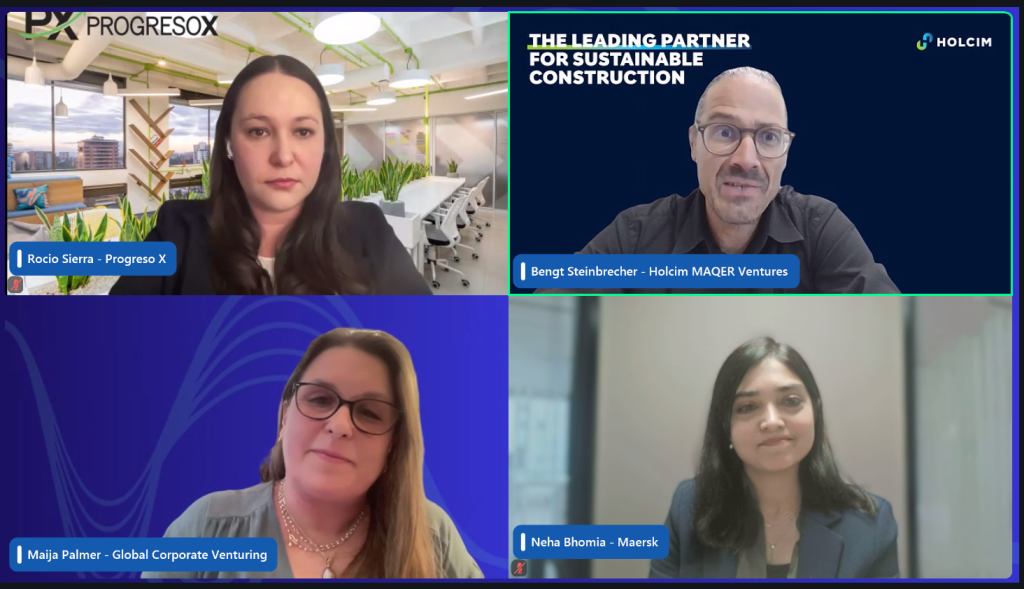
Bengt Steinbrecher, head of Holcim MAQER Ventures, the innovation arm of the Swiss construction company; Neha Bhomia, senior innovation business parter at Maersk Growth, the venture clienting unit of the Danish shipping and logistics company; and Rocio Sierra, strategy and business development manager at Progreso X, the innovation arm of the namesake Guatemalan construction company, discussed ways to get the most impact from venture clienting.
Here are nine tips that they shared.
1. Tie venture clienting directly to business strategy
Venture cleinting works best when it is not a side experiment but embedded in the company’s main strategy. Maersk, for example, moved the venture clienting team into the company’s strategy function. “We just don’t ask, is this a cool startup we should work with? We ask, is it tied to our strategic priority? Will it create meaningful impact for us? Is the business ready to actually adopt it?”, says Bhomia. “That shift has made a huge difference in how seriously the organisation engages with what we do today.”
2. Start with real pain points
The panelists stressed that technology scouting should start with solving a specific problem, not with a startup technology.
Progreso X began by trying to gain a deep understanding of its clients’ needs, both internal clients of the business units and also external clients of the company, says Sierra.
One of Maersk’s most successful test cases came from a new European Union regulation that clients were struggling to comply with. The shipping and logistics company’s consulting team saw it as an opportunity to create a new product. “That’s when Maersk Growth stepped in with a very clear problem definition. We went into the market to look for the startups who could potentially solve it,” says Bhomia.
Holcim MAQER also focuses on tangible pain points. For example, one of its pilots started after safety concerns emerged from a common industry practice of plant managers climbing 20 metre silos to check cement levels inside the structures. The venture clienting team found a startup that develops sensors that can test fill levels from outside of the silos. That technology proved so successful that it is now deployed at operations in more than 10 countries.
Coincidentally, this technology that initially removed a safety hazard meant that the company now had real-time data about inventory levels. This could be used to better time the loading and unloading of trucks, which became an extra service it could offer clients. “All of a sudden there was a new business case for quantifying a cost impact,” says Steinbrecher.
3. Make the business own the problem
Venture clienting works when the business feels the pain and owns the solution. Models where pilots are led by the business units do better than innovation-led collaborations.
Maersk requires every startup collaboration to come with a business sponsor and a problem it is trying to solve. Progreso X acts a facilitator and bridge to the startup, but experts from the business unit are the ones who decide whether the solution works and whether it should scale.
Steinbrecher at Holcim MAQER Ventures reaches out to what he calls the “alliance of the willing” – people in the organisation who show appetite for testing a solution to a pain point that they have in their local business. “This helped us early on to create buy-in,” says Steinbrecher. “It helped us get momentum quite quickly. It also helped us decentralise and get projects across our footprint.”

4. Design for scale from day one
A recurring theme is that it is only worth collaborating with startups where the technology can scale throughout the business. Holcim MAQER Ventures only pursues solving pain points if the technology can have group-wide scaling potential rather than solving one-off local problems.
Maersk Growth asks upfront: “If it’s a success, will it scale? Will it be allowed to scale?”, says Bhomia. One of the most important measurements of success is asking if the pilot will change how the business is operating today, she adds.
5. Remove any corporate-like controls that will slow down startups
Venture clienting only moves at startup speed if corporate bureaucracy is removed.
In the first months of setting up a venture clienting model, Holcim’s Steinbrecher strove for a lighter touch business environment that would not slow down collaborations with startups. This included setting up fast non-disclosure agreements, simple pilot project contracts, and exceptions to standard procurement practices that remove the need for tendering.
“At the beginning, we brought stakeholders on board, explained to them what we were trying to achieve, why we needed to deviate from standard corporate processes, and set up documents and structures for this purpose,” says Steinbrecher.
6. Measure impact with clear, upfront KPIs
Strong programmes define success before pilot projects start.
Maersk Growth looks at the financial impact – what are the cost savings and efficiency gains it is targeting. It uses a business application form that captures what the problem is, what the impact of the problem is on things like costs and productivity.
It also does this in parallel with a startup it has selected to collaborate with. It sets a baseline with the startup that it uses to measure things like efficiency gains and expense savings.
7. Venture clienting also creates more intangible benefits
Some of the biggest wins from venture clienting are hard to quantify but are also real for the business.
Progreso X, for example, became to be seen as an “ally” to its customers, says Sierra, by not just being a materials supplier but also a partner to its clients in testing technologies that can help their own businesses.
“For us, in Latin America, where digitisation gaps are real and significant, this approach has been really impactful for our clients, because they are gaining insights and data to move things forward in their operation,” she says.
Progreso’s customers have even started to volunteer to have pilots tested in their own operations.
“We are not benefiting financially from the selling these technologies. We have understood that the main value we can create for Progreso is having these clients happy and seeing that Progreso is an ally,” says Sierra.
Providing employees with broad exposure to startups also can make the workforce more open to trying new technologies, especially in sectors like construction which is not known for innovation.
“Talking with startups through such a process can spark new ideas, which can either verify the track they are on or maybe they say, maybe we should try something else,” says Steinbrecher.

8. Treat pilot projects as a portfolio not a collection of one-offs
Holcim’s Steinbrecher advises having a balanced portfolio of startup collaborations that are a mix of horizon one, two and three technologies. This means that venture clienting teams can show strategic value of both in the near and long term.
If the portfolio is skewed to horizon three, the team may have difficulty explaining the team’s strategic contribution. “If the CFO asks you, what is your bottom line impact, you will be happy to have some horizon one or two things, which are just helping to reduce costs and drive efficiency,” says Steinbrecher.
Maersk Growth learned that having too many disconnected pilots was a trap. It “felt productive”, says Bhomia, but didn’t scale and the organisation lost trust in the process. The team corrected by linking each pilot to business priorities, introducing thresholds for revenue or savings.
9. Venture clienting can create a strong footing for investment
The three panelists stress that corporations can create lots of value by just being a client of a startup, but that tie to the startup can go even deeper with equity investment.
Holcim practices a ‘test before invest’ philosophy where it will only invest once the solution has been proven in pilots. Sometimes the decision to invest can push the organisation to adopt the technology faster by deepening the “emotional” commitment to the startup.
Progreso invests in startups through partnering with VC funds, but it has also invested directly in one startup. By investing, the relationship with the startup can go even deeper and more long term. “Once you invest, you’re more invested in making them grow. It all depends on the timing and what you want to achieve from the investment,” says Sierra.
Listen to the full replay of the webinar here:
This webinar is part of GCV’s The Next Wave series. We run webinars monthly on different areas of corporate investment practice.