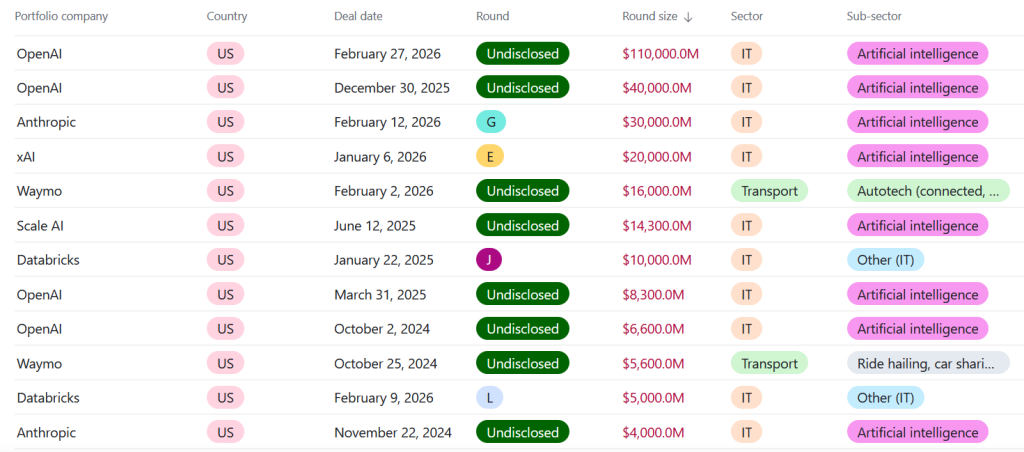
The $110bn raised by the AI developer came entirely from corporates, a sign of how big tech is funding the mega-growth at the top of the market.
The $110bn funding round disclosed by generative AI developer OpenAI at the end of the last week is a sign of just how much some corporates are now willing to invest in startups at the top of the market.
Amazon supplied $50bn of the capital, with SoftBank and Nvidia each putting up $30bn, at an $840bn post-money valuation. The round is almost triples the size of the previous largest, also by OpenAI, which closed at $41bn in December, valuing the company at $260bn.
Those rounds are the culmination of a process where AI startups have redefined the scale of venture capital funding over the past three years, with corporates more involved than ever before.
Data and AI company Databricks closed a $15bn series J round in January last year that was, at the time, the largest VC round ever. There have been five larger rounds since then, all closed in the past three months: two for OpenAI, one each for generative AI peers Anthropic – which raised $30bn under a month ago – and xAI, and one for self-driving car producer Waymo. Corporates featured in all five and led or co-led four of them.
GCV data shows that a few AI-themed startups at the top of the market are becoming accountable for a larger and larger slice of the funding pie. The last big increase in this kind of stratification came in the mid-2010’s, when a group of consumer-facing Chinese companies, like ride hailing service Didi Chuxing (now rebranded as DiDi) and Ant Financial, the mobile financial services provider now known as Ant Group, closed multibillion-dollar rounds backed by domestic internet companies like Alibaba and Tencent.
That increase was driven by two things: the potential for apps and mobile commerce to transform the economy, and the possibilities of a consumer market as vast as China’s. The number of billion-dollar rounds shot up again during the covid era, but the capital was more evenly spread across multiple startups.
Much like the app boom of the last decade, the AI rush is based on a technological leap with the power to transform the economy. Corporates are playing an even larger role this time, particularly a group of tech companies that includes Nvidia, Amazon and SoftBank, but also Microsoft, Cisco, Facebook-owner Meta and Google-owner Alphabet.
These corporates have deep pockets and a willingness to commit larger swathes of capital to startups. Although many of them have early-stage venture arms, they are funding these investments from their balance sheets, and from capital reserves that dwarf those of all but the very largest VC firms.
AI is also more directly strategic for these corporates than the app companies ever were. Microsoft and Google each have their own proprietary chatbots, Nvidia provides many of the physical chips used in generative AI, Cisco is central to AI networking infrastructure and SoftBank has put the technology at the centre of its future strategy. All that is in addition to vast AI spending plans announced by Amazon ($200bn) and Facebook ($135bn) in recent months.
This period of extreme growth at the top of the VC market is not likely to stretch far beyond 2026. OpenAI and Anthropic are reportedly both planning for IPOs this year as they look to beat each other to the public markets. Databricks could do the same, while xAI is set to merge with SpaceX in a $1.25 trillion deal in the coming months. The VC landscape will look very different once those huge players pass the startup stage, the question is whether big tech will still have the appetite for huge pre-IPO deals once they’re gone.
See all the largest CVC-backed rounds on the CVC Funding Round Database