Lam Capital’s fourth semiconductor startup competition aims to accelerate development of the underlying infrastructure to make AI run faster and more efficiently.

Spending on artificial intelligence is booming and companies are racing to create new data centres and other AI infrastructure in what is thought to be the largest build-out in in technology history.
But venture capital investment in startups advancing the “core backbone” of AI — the semiconductor technologies it will run on? That has not yet made the same big leap.
“Semiconductor-related venture funding is only at about 2 to 3% of total VC funding,” even though this is the technology stack on which AI depends, says Kevin Chen, head of Lam Capital, the investment arm of Lam Research, a US supplier of semiconductor manufacturing equipment.
“Semiconductor-related venture funding is only at about 2 to 3% of total VC funding.”
In 2025 VC investment in semiconductor startups saw a jump to $12.2bn, but that was a drop in the ocean of the overall VC $425bn spending recorded by Crunchbase. Semiconductors, like most of deep tech hardware, have been a notoriously difficult area for venture capitalists to invest in — the technologies are capital intensive and timescales to profitability can be long.
“It takes a certain stomach to be able to invest in the semiconductor domain, because it’s just so challenging. These are deep technical problems that entrepreneurs are trying to try to solve,” says Chen. “The time to exit can be long in the chip industry.”
Lam Capital is aiming to provide an accelerant for investment in technologies related to the semiconductor ecosystem through a startup competition, the biennial Lam Capital Venture Competition, running for the fourth time this year.
The competition has become a key place to showcase companies right at the bleeding edge of semiconductor development, not just for the Lam Research executives and developers who are heavily in attendance on pitch day, but VC and CVC partners who are increasingly eager to attend the showcase.
“We’re expecting to over 250 people to be attending this again, split between folks from our company and folks from the industry,” says Chen, noting that the event is starting to be “at capacity“ for the current venue at Lam Research’s headquarters.
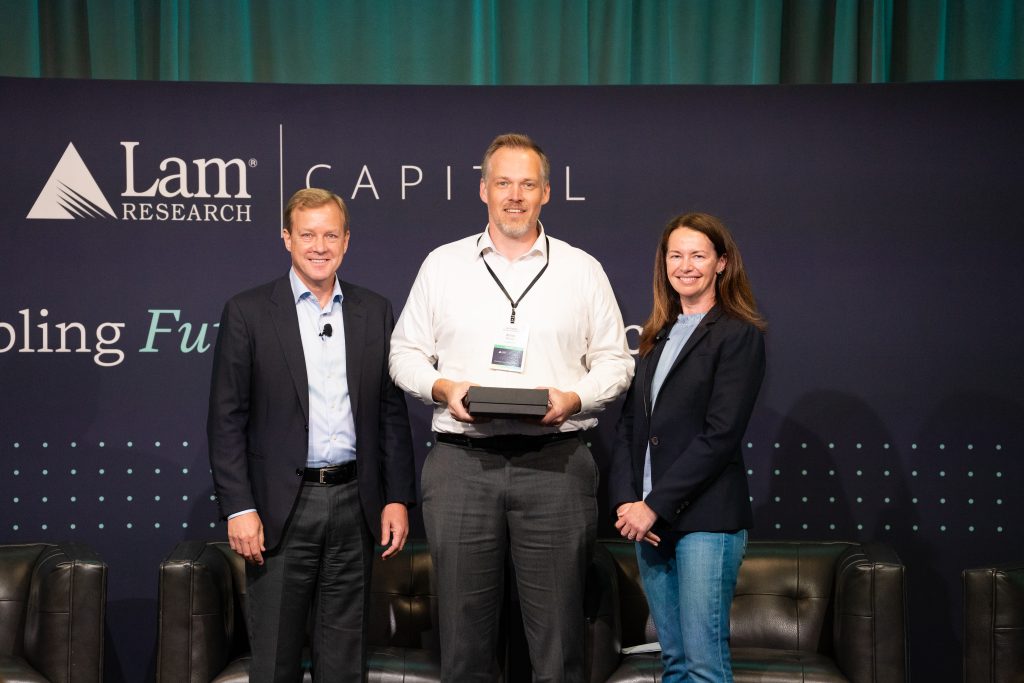
“We have our executives fully engaged. We also have our engineering community, technical community, as well as our marketing and business folks also attending and interacting with this innovation ecosystem.”
For semiconductor startups there is the prospect of winning a $250,000 prize in the form of a SAFE note investment.
“We think that this is the only competition of this type that we’re aware of in our industry that offers a tangible investment prize,” says Chen.
Lam Capital has invested in at least four prior competition entrants.
Even the startups that don’t win that top prize often walk away with investment from Lam Research and others. Lam Capital has invested in at least four prior competition entrants including co-leading the series A funding round of Lidrotec, a German startup that makes low-damage laser wafer dicing equipment for cutting semiconductor chips, and Membrion, a developer of ceramic desalination membranes and TetraMem, a Silicon Valley-based company pioneering analog in-memory computing.
Chen says areas that the Lam Capital team are keeping a close eye include interconnection technologies, such as photonics, as well as technologies to make AI datacentres more sustainable, such as handling the cooling of chips and servers more efficiently.
Advanced packaging technologies for semiconductors are also in focus, including 3D architectures and so-called heterogeneous integration technologies where multiple, specialised, and separately manufactured smaller chiplets are combined in one package for efficiency and cost.
Right now, says Chen, is a compelling moment for the semiconductor ecosystem. “It’s a high leverage kind of situation where this is the backbone technology that we’re talking about,” he says. We’re still in the early phases of the unprecedented AI boom, Chen notes. The astute semiconductor bets made now are the ones that will have the substantial pay-offs.
What startups entering the competition need to know
Lam Capital’s competition is aimed squarely at the AI hardware and semiconductor “backbone” rather than pure software plays.
Lam Capital is looking across core compute and chip technologies, networking and interconnects (including photonics), advanced packaging and heterogeneous integration, sustainability solutions for AI data centres (cooling and energy efficiency), industrial automation and robotics (“physical AI”), and AI tools that speed up semiconductor R&D – from AI for process control in fabs to AI for materials design and simulation of chips and systems. Beyond the tech domain, they assess the founding team, the differentiation of the technology, clear proof points, and whether the startup is addressing an important problem for the industry.
The Lam Capital Venture Competition runs every two years and is now on its fourth edition. It starts with a global call for applications (they receive hundreds), which is narrowed down to about 10 finalists from around the world. Those finalists are coached for the event and then come to Lam Research’s Silicon Valley headquarters, where they pitch to a panel of 5–6 industry investors (a mix of corporate and financial VCs). Pitch day is embedded in a broader programme: an investor panel, an industry panel, and a networking poster session where finalists and selected portfolio companies can present in more depth and meet attendees.
The event itself has become a substantial industry gathering with some 250 people expected to attend. The winner receives $250,000 in the form of a SAFE note investment and Lam has also gone on to invest in several runners-up and non-winning finalists.
Startups want to enter the competition should apply here by Sunday, March 15.

Maija Palmer
Maija Palmer is editor of Global Venturing and puts together the weekly email newsletter (sign up here for free).