Ben Wright, head of 3M Ventures, says material science is playing a key role in fast-moving sectors like data centres and aerospace. The investment team is helping make sure the company stays ahead of the curve.

Corporate venture units are more necessary than ever at a time of disruption and economic uncertainty, says Ben Wright, who leads 3M Ventures, the corporate venture arm of 3M.
Geopolitical uncertainty, high interest rates and a new war in the Gulf region are casting a volatile shadow over the venture world with many units retrenching or restructuring. But Wright believes that rather than sounding the alarm, the current era of disruption is precisely the time to lean in to venture more heavily. The time when multiple industries are being reshaped at the same time is when CVCs can really show their value.
“The disruption we’re seeing, in my opinion, actually enhances the case for CVC. It should be viewed as a necessity for corporations,” he says.
Often, however, in troubled times, corporations can lose faith in their startup investment vehicles. The difficulty often stems from the very reasons CVCs were created in the first place, says Wright.
“We’re created because the company recognises that they’re focused on the short term. They need a group to look externally and focus on the longer term,” he says.
“But then, when a company becomes even more short-term focused or comes under financial pressure, the easiest thing to cut is the longer-term growth programme.”
Data centres and aerospace in focus
For a material science company like 3M, which has a foot in many sectors, its venture team is in a prime position to capitalise on the rapid advance of a range of technologies that will need materials innovation.
The 3M Ventures team is focusing particularly on the data centres and aerospace sectors this year, both of which are undergoing rapid change.
The compute demands of increasingly complex AI models are driving the need for advanced semiconductors and processing hardware. Data centre infrastructure is being redesigned from the ground up. 3M Ventures portfolio company Cell Link, for example, is making flexible circuits that allow data centres to connect their server racks significantly more easily – a materials-science solution to an AI infrastructure problem.
Beyond the computing infrastructure itself, there is innovation in thermal management and cooling, as well as the associated baseload energy technologies like small modular nuclear, grid infrastructure or energy storage to bring in intermittent renewables. These are as much a materials science problem as they are an infrastructure build-out problem.
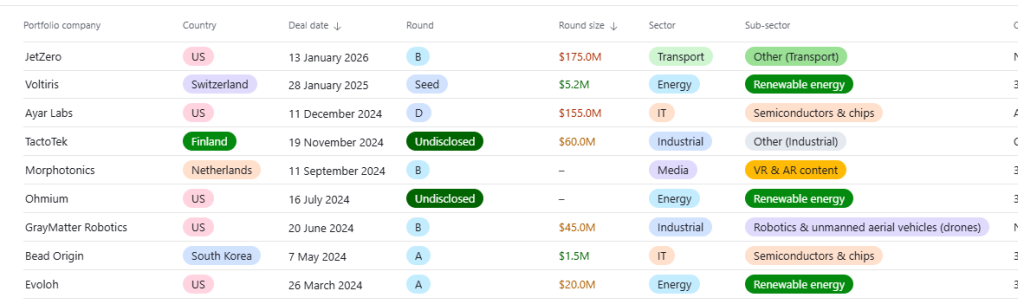
Geopolitical turbulence is driving demand in aerospace and defence, leading to what Wright – a former aviation officer and helicopter pilot in the US Army – calls the biggest change in our lifetime for the sector. 3M Ventures sees strong investment opportunities in drones, counter-drone technology, autonomous and electric aircraft, as well as completely new aircraft designs. 3M’s portfolio company, Jet Zero, for example is making blended wing-body designs aimed at increasing fuel efficiency by 50%.
“For a company like 3M with a deep set of expertise in material science, it’s really positioned to help bring these innovations to life,” says Wright.
“That’s why, to me, having 3M Ventures is as important as it ever has been – because we’re the mechanism to help partner with these companies.”
Some potential dual-use technologies are less obvious than drones, and right in 3M’s wheelhouse. Augmented reality tech like that made by 3M Ventures portfolio company Dispelix, which designs and produces waveguides – the micro-structure pattern that allows a user to see through something while being able to superimpose an image on a heads-up display – could be applied to both civilian and defence contexts.
“People think of defence primes like Boeing and Raytheon, and then companies like Anduril that compete with them, but they have a whole supply chain beneath them that they need to make this work,” says Wright.
“Drones need lightweight materials, advanced solutions to maybe camouflage or cloak the drone. There is a lot of material science needed for that.”
Space is similarly becoming easier to invest in by virtue of decreasing launch costs, opening the door to a massive future market for materials that can work in extreme environments.
“Turns out [materials made for space] have really interesting applications on Earth, too,” says Wright.
Showing the value
Financial returns remain necessary, he says, but they are not sufficient. It’s ultimately the strategic value that keeps a CVC unit in business through leadership cycles, economic downturns and the structural paradox of being a long-horizon function inside a short-horizon organisation.
The macro backdrop, he says, has heightened his team’s focus on demonstrating tangible benefits.
“We have a goal on our team to just deliver quarterly wins, and wins that are recognised within the company as moving the needle on either innovation and growth.”
See all the deals by 3M in the CVC Funding Round Database

Fernando Moncada Rivera
Fernando Moncada Rivera is a reporter at Global Corporate Venturing and also host of the CVC Unplugged podcast.