Arabsat, Eutelsat, NEC and Sky Perfect JSat have all backed the venture firm's second fund, as corporates take a wider interest in space tech.
A host of satellite and electronics companies have backed UK-headquartered space technology investor Seraphim Space’s second fund, which closed at more than $100m this week.
Satellite operators Arabsat, Eutelsat and SKY Perfect JSAT joined electronics manufacturer NEC and UK government institutions the British Business Bank and National Security Strategic Investment Fund as limited partners. The range of strategic LPs has widened considerably since Seraphim was founded in 2016, says CEO Mark Boggett.
“When we started, corporate interest was largely from traditional space and aerospace players,” Boggett tells GCV. “Today, interest comes from a much wider range of industries that rely on resilient connectivity, such as geospatial intelligence and real-time data, spanning defence, infrastructure, climate and life sciences.
“Investing via a specialist fund allows corporate LPs to gain broad exposure to emerging technologies, access global early-stage deal flow and benefit from deep technical diligence without having to build that capability internally. Many corporates also value the structured engagement a fund provides with multiple businesses.”

Seraphim invests in startups looking to commercialise and accelerate technological development in space, an area that is becoming increasingly busy, particularly in the light of the planned trillion-dollar merger between Elon Musk’s satellite operator SpaceX and AI developer xAI.
Key markers, Boggett says, include “the scale and consistency of capital being deployed, the growing number of later-stage rounds as companies transition from R&D into commercial rollout, and rising participation from strategic corporate and institutional investors.”
The firm’s portfolio includes satellite analytics provider Spire Global, which went public in 2021, and ICEye, the radar satellite constellation operator valued above $2.5bn in its most recent round, in December.
Seraphim began raising cash for the SSV II fund in 2024 and has already invested in 17 companies. Portfolio companies include LambdaVision, which uses zero-gravity conditions to develop artificial retinas. Another portfolio company, Delos, uses satellite imagery to offer property insurance for customers in areas with a high risk of natural disasters.

“Space technology has become a core layer of global infrastructure,” says Boggett, adding that it is “increasingly central to defence, security, climate resilience, connectivity, life sciences and next-generation space infrastructure.”
Seraphim’s figures place global space tech investment at $3.8bn in the fourth quarter of last year and $12.4bn for the year as a whole, a new peak for the sector. The definition of space technology is also still expanding, Bogget says.
“Looking ahead, the definition will continue to broaden as space becomes embedded into everyday digital infrastructure, with space-based sensing, communications and computing, operating as an invisible but essential layer underpinning the global economy,” he adds.
“Spacetech is increasingly central to defence and dual-use capabilities, climate resilience, healthcare innovation and next-generation industrial infrastructure, creating new opportunities for collaboration, public-private partnerships and global economic impact.”
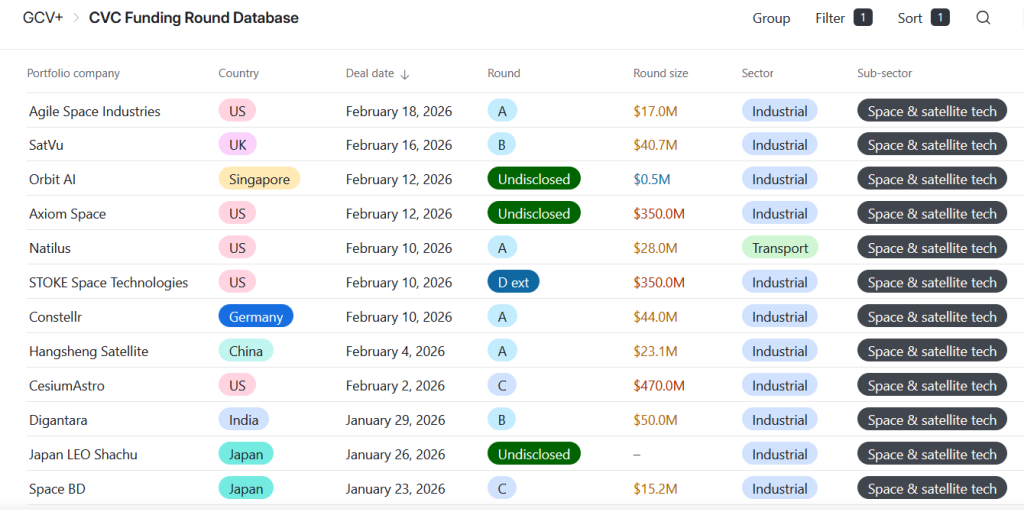
See all the recent corporate-backed space tech deals the CVC Funding Round Database