There is a broadening recognition that critical underwater infrastructure – energy cables, offshore wind connections, subsea communications networks – is both strategically vital and chronically under-protected.
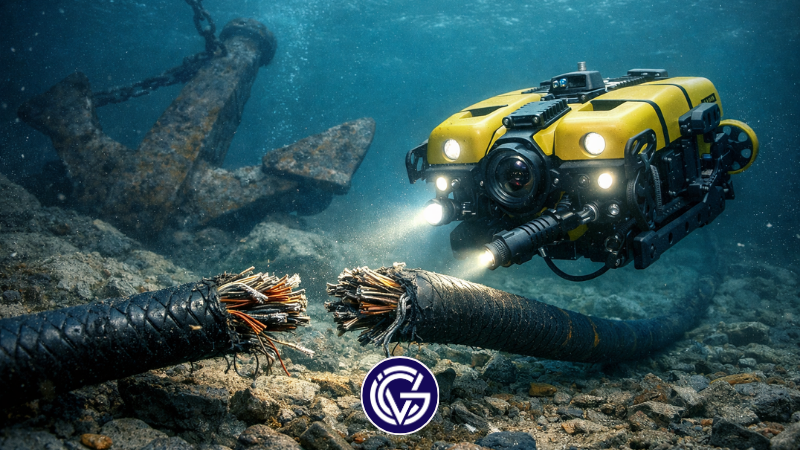
With the UK’s defence secretary last week revealing an elaborate Russian submarine operation to survey the island’s sub-sea infrastructure, while the world’s economy is held hostage by dual blockades on a narrow waterway in the Middle East, investors’ increased focus on maritime defence technologies in recent years seems vindicated.
Over the past year, startups like autonomous water drone makers Saildrone and OceanAero – as well as other companies like satellite imaging technology developer ICEYE, which have massive maritime applications – have received investment from corporations including Lockheed Martin, James Fisher, Saab and others.
Meanwhile, venture capital funding is flowing to startups like autonomous warships developer Saronic Technologies, which last week raised a $1.75bn round led by Kleiner Perkins.
In markets like Europe, especially, as national defence budgets are ramped up, investors see it as a fruitful area for deploying capital. There is a broadening recognition that critical underwater infrastructure – energy cables, offshore wind connections, subsea communications networks – is both strategically vital and chronically under-protected.
Enlarged budgets don’t translate into capital being deployed right away. The core miscalculation has been one of timeline. When European governments announce significant defence spending increases, the figures are real, but the path from political commitment to deployable contract is far longer, and far more structurally constrained, than a press release conveys.
“If we say there’s €19bn in additional budget for the Dutch Ministry of Defence, that sounds like a lot,” says Stephan Rutten, CEO of Lobster Robotics, a Dutch startup developing autonomous underwater drones for seabed inspection and maritime security.
“But it’s spread out over maybe the next ten years. And the fact that they have it doesn’t mean they can spend it.”
Rutten has been navigating this reality firsthand, working under contract with the Dutch Navy on, among other things, investigating and assigning attribution to acts to subsea tampering or sabotage. The institutional credibility is unusually high for a company at their stage. The bottleneck is elsewhere. “The generals have told them to spend it faster,” he says, “but the generals haven’t made the rules any easier. They’re trying to force a lot of money through the same opening.”
For Lobster Robotics, which was part of NATO’s accelerator programme DIANA, a cultural shift that has made defence technology more palatable also works in its favour. When it started with DIANA in early 2024, says Rutten, defence was a dirty word. That is no longer true.
The corporate advantage
This is the environment that corporate VCs, by virtue of living inside the industry, were better positioned to anticipate. Sean Huff, who heads James Fisher Ventures, the CVC arm of UK-based marine services group James Fisher & Sons, describes a framework shaped by operational experience that generalist investors simply don’t carry.
“We’re a vessel owner. We face all of the same challenges that bigger vessel owners face,” he says. “Our team that works in there has that perspective, which we can benefit from as an investor. All of our energy projects work offshore. Our defence division focuses entirely on the offshore environment. It’s all focusing on the same physical environment, but all from different perspectives.”
James Fisher operates across maritime services, offshore energy, and defence, and its venture unit approaches investments through what Huff calls a seabed-to-space lens – every layer of the maritime environment, from subsea infrastructure to satellite monitoring, represents both a threat surface and an investment thesis.
“Three, four, five years ago, this whole space was really underappreciated. You didn’t have as much of the venture market going after it and investing in technologies, either because it was too hard to penetrate, or it was too niche, or they didn’t have the skill sets to assess technology. There was not a lot of technology to go after. I feel like that’s totally changed,” says Huff.
The water surface – the traditional vessel environment that is the most accessible and visible – says Huff, is where the market is most mature and technology is less about being transformative as it is about being more efficient. The closer you get to the seabed, the higher the risk, but the more open the field. The air above the water, and outer space above that, present more opportunity for future technologies to make their mark.
“There are elements that cut through the entire thing, which is generally around data,” says Huff. “How do you capture data from all of those different spaces, and how do you integrate it and make sense of it?”
That embedded perspective changes how Huff reads a startup’s prospects. Where a financial VC might assess a maritime defence company on addressable market and growth trajectory, a corporate investor can interrogate the operational assumptions – whether the technology actually works in the offshore environment, whether the customer relationship is genuine, and crucially, whether the company has structured itself to survive the defence-tech valley of death.
As with other defence-tech, this puts a premium on dual-use technology that doesn’t live and die by defence contract. While it creates a problem of focus for resource-strapped startups that need to serve a client, going after two markets is a big bonus when trying to raise money.
According to Huff, defence buyers are increasingly willing to go to the commercial market to find technology, rather than get it only through traditional tenders.
Speed is a weapon
Startups can’t compete with incumbents on scale, but as the threat landscape changes rapidly nimbleness becomes a real asset. It is difficult to adapt to constantly evolving adversaries with the same technology.
“This constant arms race in drone technology, or in jamming technology, requires speed as a capability in itself, not just a means to an end. And that’s something you cannot build or buy if you are a prime. It’s quite difficult to,” says Rutten.
As a result, there is an asymmetry that smaller companies can take advantage of, and have as leverage over primes in negotiations.
Beware the vapourware
The rapid proliferation of drone technology has not necessarily made the market move quicker, in all instances. It has also been a constraint.
“There’s a lot of vaporware floating around,” Rutten says, “making buyers suspicious and extra careful, which slows everything down.”
The effect is that at the very moment defence demand is increasing, buyer confidence is being eroded by noise, and institutional validation is consequently becoming a primary differentiator in a crowded field. Here the neo-primes have an advantage, including in the budget they have to hire former military brass to their boards as a market signal.
Lobster Robotics validated its core technology surveying offshore wind farms before it ever approached a navy. The Dutch Navy is now co-developing a military variant of the same platform, adapting it for things like encrypted communications and classified data handling, with the underlying technology essentially unchanged.
“We had a commercially proven concept in offshore wind,” Rutten explains, “and the Dutch Navy is now taking it, giving us feedback, and shaping it into a military variant.”
Both the Netherlands and Estonia, where Lobster Robotics has also done work, have signalled a preference for commercially proven systems over purpose-built military prototypes, because a civilian operational record provides evidence that a defence specification document cannot.
Ultimately, the move to unmanned vessels in the maritime space seems to be structural, not just cyclical. The technologies that are coming online are set to leave a permanent mark.
“Some of the technologies that are emerging are displacing previous ways of doing work,” says Huff.
“The autonomous vessel space, whether surface or subsurface, is displacing a traditional way of doing work. And I just can’t see that ever coming back, because it’s far cheaper and safer to do it the new way.”

Fernando Moncada Rivera
Fernando Moncada Rivera is a reporter at Global Corporate Venturing and also host of the CVC Unplugged podcast.