Maritime services company James Fisher launched a new corporate VC arm to look for new undersea technologies.
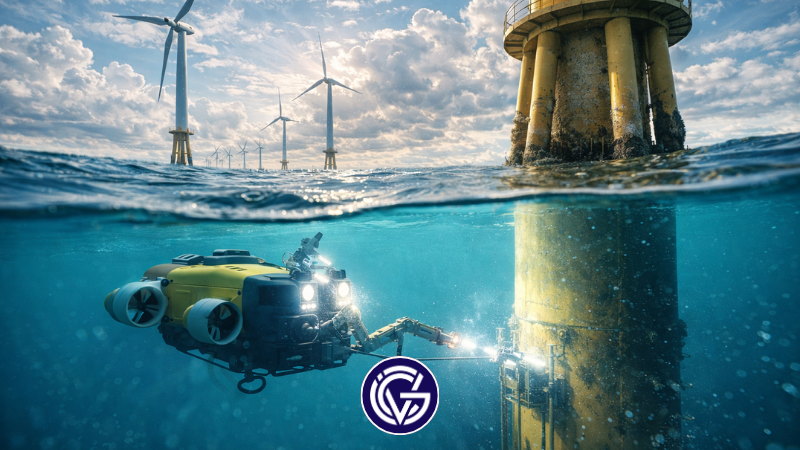
Amid increased news of undersea sabotage and spying, marine services company James Fisher recently launched a startup investment arm that is looking for technologies that can help secure underwater assets.
“We’re a service company that is contracted to militaries, to large oil and gas companies and big utilities. The major trends that are happening in the world – we’re impacted by that through our clients,” says Sean Huff, chief digital officer and head of ventures at the UK-based marine services company.
“We focused on energy security and energy transition because it feels like our entire world is being driven by those two major themes.”
“We focused on energy security and energy transition because it feels like our entire world is being driven by those two major themes.”
Geopolitical tensions have accelerated investment in protecting maritime assets, particularly in Europe as it works to reduce defence dependence on the US. Both the importance and the vulnerability of underwater infrastructure has come into sharp relief over the past few years – headlines about sabotaged energy pipelines, as well as communications or electrical cables being damaged has made it clear how much jugular is really showing.
“I think Europe maybe is a relatively unique in that space to try to develop those capabilities,” says Huff.
“It’s even more unique in that it tends to be a private and public mixture. You’re having private companies with their technology, then you’re having the militaries who are the response capability.”
Late last month, the unit made its first announced investment in the series D round for Ocean Aero, a US-based ocean drone operator that has made what it calls the world’s first autonomous underwater and surface vehicle.
Understanding the new ocean economy
Undersea technologies are a very specialised niche. “As a general rule, everything’s harder in the water,” says Huff.
Any technology that exists above the surface, he says, only becomes more challenging to make work once waterborne. It’s the ones that can survive that transition that will attract attention from James Fisher Ventures, the corporate’s newly-minted startup investment arm.
“As [technologies] marinise and move into the ocean, are they still adding real value? Are they changing the way the work is done?” says Huff.
James Fisher, which is headquartered in Barrow-in-Furness, where the UK’s nuclear-powered submarines are designed and built, provides a variety of specialist services, from submarine rescue systems, diving equipment to management of offshore energy services, including wind turbine repairs.
The company emerged from the Covid pandemic with a leadership change, divested a number of its subsidiaries and reframed the external view of its business into three main verticals – energy, maritime transport, and defence.
The newly formed venture unit is looking for the gems in the overlaps, in areas like autonomy, robotics, offshore electrification, novel sensing technology and communication protocols for underwater emissions management.
Being close to startup technology, and understanding how James Fisher’s clients are using it, can influence the strategic direction of the company, says Huff, adding that having a portfolio of startups that address the future needs of its market is highly attractive.
The company’s own internal product development function has itself been turbocharged in recent years and the investment team aims to work closely together with this unit.
“ The idea is that those two work hand in hand. Say [our new product development team] is deploying x-million of capital on a new product, the CVC team is there to balance that and say, did you know there are five other things in the market that look similar to that?” he says.
Providing startups with access to markets
“I always tell companies that come talk to us that they could find money somewhere else. You don’t come to James Fisher Company looking for money,” says Huff. The company does invest actual cash in startups, but Huff emphasises that this is not the main draw.
“You come for access to clients or to test your technology in the market. A lot of the value that we bring is getting unique access to challenging markets.”
James Fisher Ventures will look to bank on the depth of domain expertise of its corporate parent which, in addition to its general maritime operational knowledge, also provides unusual services like submarine rescue for navies around the world. Startups with that kind of unique value proposition, they hope, would see them as a valuable partner in trying to get technologies adopted by unique customers like navies.
The unit invests between series A and B, looking for startups with commercial risk but not technology risk. At this early stage, it has a four-strong investment team, and can lean on corporate resources for legal support and financial analyses.
The venture team makes investments from the corporate balance sheet rather than having a separate fund. This is a conscious choice, says Huff, as the unit wants to be part of the business, not a separate entity pushing things into the business.
The team has a global remit, with its scouting tending to focus on maritime Europe, the US, Brazil and Australia, though James Fisher’s larger footprint also includes the Middle East. Typical investments will be up to £1m per startup, with opportunity for follow-ons down the line, as well as a board observer seat.
The unit is not in a hurry to deploy capital, according to Huff, who says the main focus will be on finding the good ones, which will likely translate to a handful of investments per year.

Six unmanned water vehicle startups to watch
Water is the next frontier for drones and unmanned vehicles – here are six startups making waves.

Fernando Moncada Rivera
Fernando Moncada Rivera is a reporter at Global Corporate Venturing and also host of the CVC Unplugged podcast.