Quantum is on the cusp of moving from research to commercial use and companies are exploring its potential for improving diagnostics and the discovery of new drugs.
Biopharmaceutical companies see quantum as a potentially transformative technology for the healthcare and pharmaceutical sectors, with investors such as Danish life sciences investor Novo Holdings ramping up VC investments in the technology.
Novo Holdings, whose pharmaceutical subsidiary Novo Nordisk, the maker of weight loss drug Wegovy, made an anchor investment in newly launched quantum technology investment fund 55 North this month, as part of its strategy to build a portfolio of fund investments as well as direct investments in quantum. Novo Holdings and EIFO, the export and investment fund of Denmark, invested €134m ($155m) in the first close of 55 North’s inaugural fund.
Quantum is on the verge of moving from “interesting scientific research, into something really commercial.”
“Novo Holdings has been very interested in diversifying their asset portfolio but also looking at what the future of healthcare might be – how do you improve drug discovery, how do you improve patient treatment,” says Owen Lozman, managing partner of 55 North. “From their point of view, they are very interested in developing this technology.”
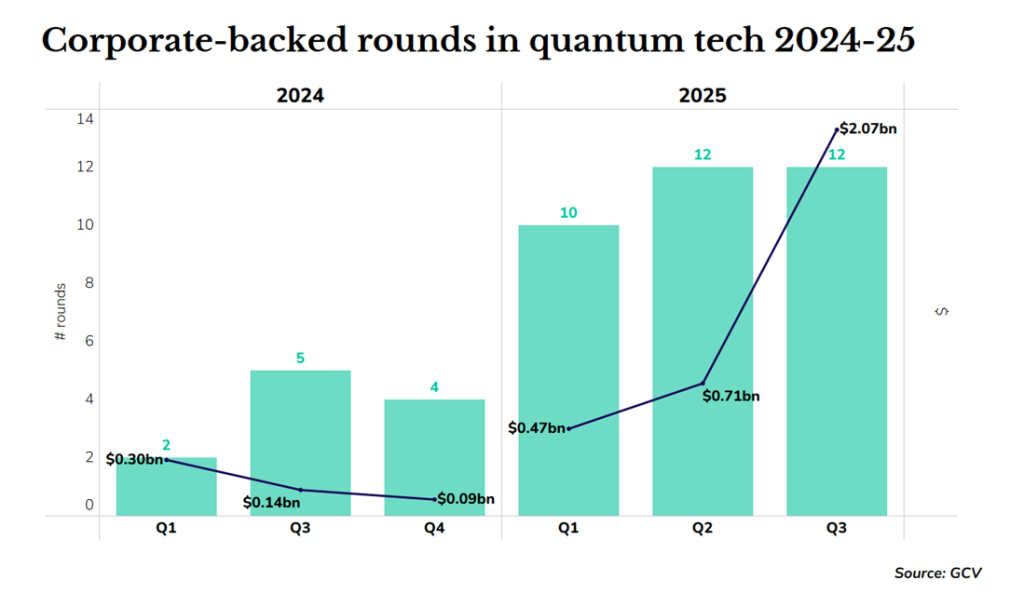
Quantum is on the verge of moving from “interesting scientific research, into something really commercial,” says Lozman. Growing interest in its market potential is reflected in the increase in venture capital investment over the past year. The value of corporate-backed rounds in quantum startups have increased more than threefold since the start of 2025.
Novo Holdings has committed €188m to quantum technology, with emphasis on applications that can impact the life sciences sector. Over the past few months, it has made several direct investments in quantum startups in addition to the 55 North fund investment. It took part in the $92.6m funding round for QuNorth, a new joint venture established to buy and operate a commercial quantum computer based in the Nordics, in July. The company is owned 50/50 by EIFO and the Novo Nordisk Foundation.
Novo Holdings also contributed to the $34m series B round for Phasecraft, a UK spinout from the University of Bristol and University College London, which develops quantum algorithms. Novo Holdings co-led the investment with VC investor Playground Global in September. It was the first direct quantum software investment Novo made through its new quantum fund.
Other European pharma groups investing in the sector include Danish pharmaceutical company Lundbeck, which invested in the $10.8m seed round for Kvantify, a Denmark-based quantum computing-powered drug discovery technology developer, in July last year.
US biopharmaceutical Amgen, meanwhile, took part in the $600m raise for Quantinuum, a developer of fault-tolerant quantum computing systems, in September. The fundraise valued the UK-based startup, a spinout from Cambridge Quantum Computing and Honeywell’s Quantum Solutions division, at $10bn.

55 North, a €300m pure-play quantum fund, has made two investments so far – both in European startups. It invested in the $320m series B fundraise for Finnish startup IQM Quantum Computers, a maker of full-stack superconducting quantum computers; and in the €13m round for German quantum cooling technology developer Kiutra.
Although many of the quantum startups that raised capital recently are European, 55 North’s investment focus is global. Lozman says the sector “is still a little bit away from where you have computers which can do useful calculations that would really help the life sciences.” But it is making investments in areas that could eventually achieve that, he says.
Focus areas include quantum hardware technologies such as cooling, interconnects and packaging, as well as software, quantum sensing and other enabling technologies.
“There are a lot of areas where quantum technologies are starting to mature. There are a lot of laser timing applications that are great for things like sensing,” says Lozman. “There’ll be a lot of applications where you can improve diagnoses and improve the resolution of MRI imaging.”
Read more