Europe's AI opportunity lies in the application layer — particularly with agentic AI — but a lack of capital means the continent could lose out.
Would you have rather invested in the internet in 1995 or 2000? With hindsight, it is easy to answer ‘1995’. I believe we are standing at a similar inflection point with AI: the foundations are laid, and the world is about to adopt its applications on a massive, and transformative, scale.
Those foundations, however, have been laid in the US; Europe risks being cast aside in the AI race. US companies have built the semiconductors, the high-performance data centres and the foundational models for generative AI. Meanwhile, for Europe, the opportunity lies in the application layer – particularly with agentic AI – but a lack of capital for start-ups and scale-ups means the continent could lose out altogether.
There is already a striking investment gap. According to the ‘State of Global VC’, the US is taking the lion’s share of the world’s venture capital, leaving Europe trailing behind. In terms of pension fund investment, 10% to 15% of US pension fund assets are invested into private equity and venture capital combined. In Europe, they invest a meagre 0.12% into venture capital.
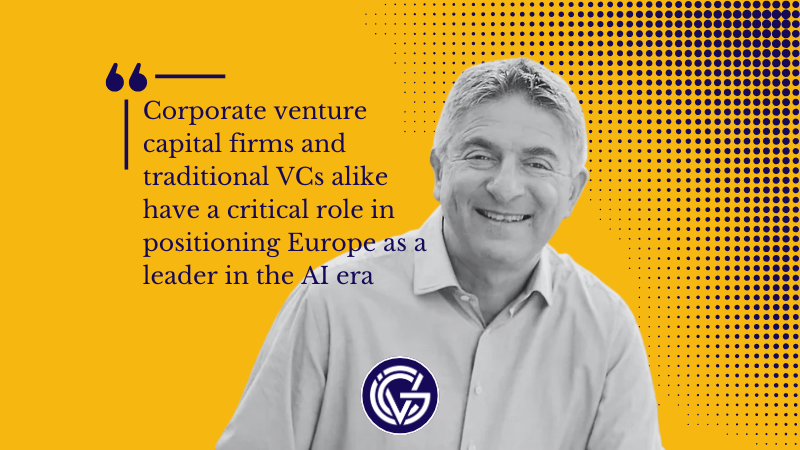
While there are initiatives to boost the allocation of pension funds, the pace is not keeping up with the rapid development of AI applications. More capital – primarily from private sources – is urgently needed, and corporate venture capital firms and traditional VCs alike have a critical role in positioning Europe as a leader in the AI era.
Agentic AI applications are poised to transform how people work and how organisations operate. Whether it is lawyers referencing previous judgments, sports clubs monetising their video clips, or doctors checking symptoms, every mundane and manual task will be affected.
CVCs should form strategic partnerships
The challenge for corporate investors is in selecting – and winning the right to invest in – the most promising scale-ups, and to manage the investments once they’ve made them. Working with seasoned VC managers can solve this problem; a strategic partnership will allow CVCs to invest in European AI with VCs that already have a track record in this space.
Oxx, for example, invested in AI-powered video discovery company Moments Lab alongside CVC Orange Ventures.
These kinds of partnerships are an ideal source of direct investments, and CVCs can do this in a cost efficient way by leveraging – rather than trying to replicate – the team, infrastructure, know-how and networks that the best VC firms have already put in place.
Corporates should leverage their investments
As well as the financial return, CVCs investing early in this adoption cycle will gain insights from being on the cutting edge of the technologies that will impact their sectors, whether that is pharmaceuticals, education, financial services or other industries. CVCs can leverage their VC and investee company relationships to gain insights for their business lines, and to be at the forefront of AI adoption – and keep one step ahead of their competition.
Now is the time to act, to get ahead of pension funds
If investors were open to taking minimal risk now, by investing in AI-facing venture capital firms, they will get ahead of the pension funds, who will likely join later (in what could be their equivalent of investing in the internet in early 2000).
Given the initiatives that are currently underway – such as France’s Tibi and Germany’s WIN [Growth and Innovation Capital] initiatives – to boost investment, a wall of money will likely come into the sector in the next few years. If we don’t act now, there is a risk that there will be little investment in the near term, and when the pension money does arrive into AI ventures, it will be too late in the adoption cycle. There may also be a glut of investment that will drive a bubble, which in due course will then burst, leaving investors disappointed and triggering a nuclear winter for venture capital.
Investing now will not only stimulate innovation and set up Europe to be a leader in AI, it will take advantage of the excellent exit environment which is coming in a few years’ time for the AI companies that are funded today.
Richard Anton is the Co-Founder and General Partner at Oxx, a venture capital firm that partners with the most promising European B2B software companies at the scale-up stage.