Traditional practices in finance, agriculture, energy and the creative industries are being broken down as blockchain technology ushers in faster and more streamlined transactions.

Larry Fink, chief executive of BlackRock, has become one of the most prominent champions of financial tokenisation. Speaking at the World Economic Forum in January, he argued that representing financial assets digitally on blockchain infrastructure could reshape capital markets by lowering costs and widening access.
But tokenisation is no longer just a theory debated by asset managers and regulators. The uptake of tokenisation is steadily growing. McKinsey estimates the tokenised market (excluding cryptocurrencies) could reach $2 trillion by 2030.
Across several industries — from finance and agriculture to energy and creative media — startups are building platforms that turn real-world assets into blockchain-based tokens that can be traded, financed or tracked digitally.
Many of those startups are backed by large corporations experimenting with how tokenised infrastructure could reshape their industries.
Here are four sectors where tokenisation is already being deployed — and the corporate-backed companies building the technology.
Finance
Funds, government securities, corporate bonds, equities – these common financial assets can be turned into digital assets and distributed and traded on the blockchain without the need for an intermediary.
Tokenising assets and putting them on the blockchain broadens the access of financial assets to a much broader section of the population. Some types of trading accounts, especially those that carry higher risk, can be subject to minimum net worth thresholds. But a public blockchain is open to everyone, allowing users to buy and sell financial assets directly using a smart phone without the need for a broker.
This is the idea behind Libeara, a startup tokenisation platform spun out of banking group Standard Chartered. The company was founded by Aaron Gwak, CEO, who had the idea for the company while working at Standard Chartered as regional head of capital markets for Southeast Asia. He saw tokenisation and blockchain as a way to connect issuers and investors directly, without all the intermediaries in between.
“The Libeara thesis is actually to use token technology to rebuild capital markets from the ground up, making it easier for individual investors to access simple or complex products but with much less of an overhead than it takes today,” says Gwak.

Traditionally, intermediaries have existed to make sure an asset is not fraudulent. But blockchain technology lowers the risk of fraud as it operates on a distributed network of computers. This means that no single entity has control over the entire system.
“Now we have a technology that doesn’t need to have an intermediary tell us that this is real and this is yours. It was very clear to me that this is how we could revert capital markets back to when it was personal and where it was me owning an asset, not being told what my net worth was,” says Gwak.
The company’s tokenised assets are regulated and are subject to securities laws. Owners of the tokens receive the same level of protection as a physical document of ownership, says Gwak. “Blockchain technology was built to make it an equal and level playing field between the big guy and the little guy. We want to make sure that everyone who buys a token has the same level of investor protection as any other security cleared by any other mechanism.”
Among Libeara’s services is a tokenisation platform for funds, which allows managers to issue tokenised fund units directly to investors. It also has a service that allows central banks and government treasuries to issue tokenised bonds. Investors can buy tokenised government bonds directly and store and manage their tokens in digital wallets. The tokens can be redeemed and transferred using blockchain technology.
Two of Libeara’s biggest customers are Wellington Management, a US investment manager, and China Asset Management, based in Hong Kong.
The company is backed by SC Ventures, the investment arm of Standard Chartered. As it prepares for a pre-series A round, it is seeking to diversify its cap table with the participation of the Web3 sector.
Agriculture
The entire supply chain of agricultural commodities such as soybeans, corn and wheat is being put on the blockchain to improve the transparency, transaction speed and traceability, from the supplier to the end customer.
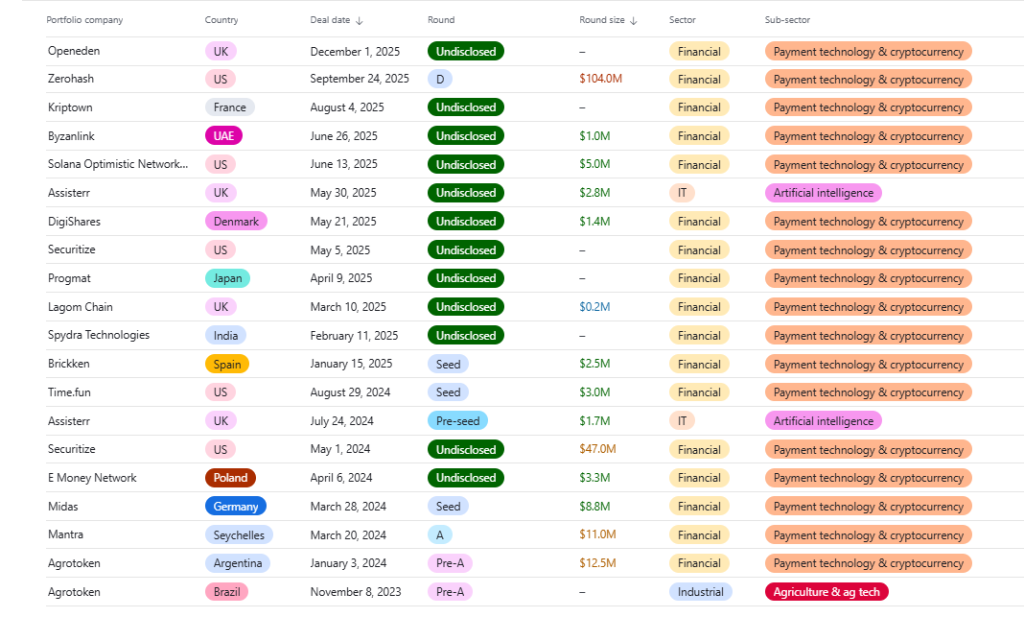
Brazilian startup Justoken (formerly known as Agrotoken) has created blockchain infrastructure that allows agribusinesses to monitor, trade and finance the underlying agricultural products. The platform uses a combination of blockchain, satellite data and AI to improve traceability and environmental compliance in the trade of agricultural commodities.
Bunge, a big agribusiness player which has invested in Justoken, partnered with the startup on a blockchain platform to ensure that soy and soybean meal sourced by Bunge in Brazil and supplied to buyers in Southeast Asia does not come from areas of deforestation.
The blockchain allows digital tracebability of the grain, from the origin on the farm, through processing and transportation to its final destination.
Visa, Argentina’s stock exchange BYMA, and Banco do Brazil, the largest lender to farmers in Brazil, also invest in Justoken.
“We’ve been in the industry for five years now, and everything is picking up very fast,” says Eduardo Novillo Astrada, CEO and cofounder of Justoken. “The adoption [of tokenisation] is really happening now, and it’s going to be a game-changer for the agribusiness industry.”
Energy
Blockchain is also playing a part in streamlining the contracting of energy. It can be used by renewable energy providers, for example, to expand the number of customers they sell electricity to.
Justoken developed a platform in partnership with YPF Luz, an Argentinian power producer, to digitise and manage electricity sold initially to industrial customers. The contracting of renewable and thermal energy is fully digital, from setting commercial terms to energy delivery. Users can monitor in real time the contracted energy, conditions and payments and participate in the financing of tokenised energy projects.
The same idea could be used in the trading of oil and gas, allowing for the fast and efficient settlement of trades, as well as the buying and selling of carbon credits for compliance to environmental regulations.

Creative industries
Tokenisation has also made a mark in creative sectors such as fine arts, entertainment and gaming. In February this year, Gumi, a mobile entertainment content producer, participated in the $1.5m pre-seed round for Xross Road, a Web3 platform for collaborative creation and monetisation of Japanese anime IP using AI and blockchain technology.
In October last year, Nvidia, Alibaba and Neom invested in the $41.6m funding round for Astra Nova, a Saudi Arabia-based Web3 role-playing game developer.
Auction house Christies has invested in several Web3 companies through its investment arm, Christies Ventures. One of these is Manifold, a startup that allows users to publish their creative works on the blockchain. Artworks can also be tokenised, allowing consumers to own shares in a piece of art. The process integrates insurance, proof of ownership and provenance on the blockchain.
See all the recent corporate-backed tokenisation startup deals in the CVC Funding Round Database