The company's new incubator plans to spin out companies based on academic research as well as its own technologies developed in-house.

UK defence company BAE Systems plans to accelerate the pace at which it spins out companies based on university research through its new incubator, Launchpad.
Europe’s largest defence contractor launched the incubator last week with the aim of spinning out dual-use defence ventures based on technologies developed in-house as well on early-stage research from European universities.
It is working with UK deep tech venture builder STL Tech to help it commercialise the ventures coming through the incubator.
“The pace at which the cutting edge is moving requires us to really look earlier than we typically would with R&D.”
David Ewing, head of technology commercialisation at Launchpad
BAE Systems already works with six UK universities to commercialise research but wants to speed up the pace at which it takes research-based technologies forward as it seeks to meet accelerating demands for defence tech development.
“What we are seeing in defence is the technology cycles have become so much quicker over the last few years. You’ve seen with the war in Ukraine that technology development, which would usually take maybe a decade, has happened in a couple of years,” says David Ewing, head of technology commercialisation at Launchpad.

“The pace at which the cutting edge is moving requires us to really look earlier than we typically would with R&D.”
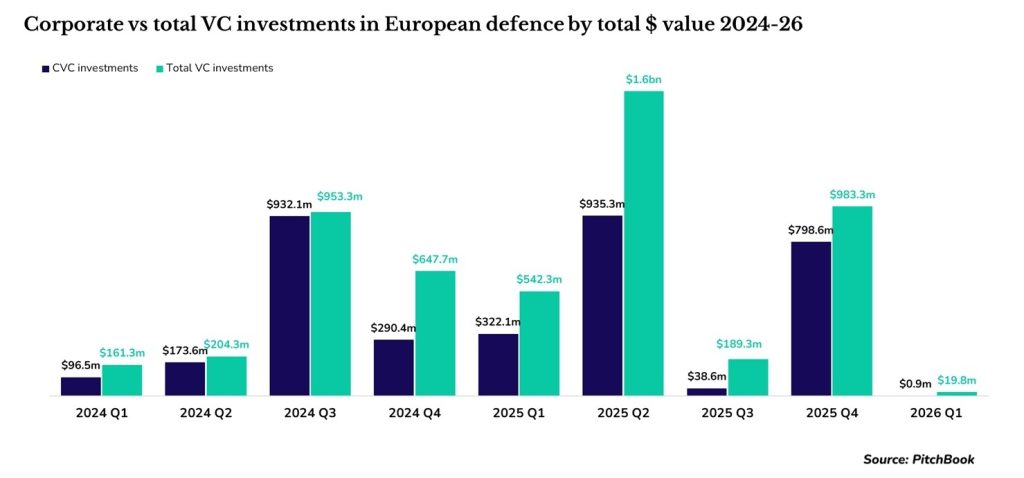
The launch of the incubator comes as European government spending on defence increases and VCs pour money into European defence tech startups. In the second quarter of 2025, total VC funding for European defence companies topped $1.6bn. In the last quarter of 2025 just under a billion dollars of total VC money was invested into the sector.
First spinout taps VC funding
BAE Systems has a pipeline of internal technologies at various stages of development that it plans to commercislise via the incubator. Its first spinout, Rho-C, allows power and data to be transmitted through solid materials without the need to drill holes for cables. This makes it easier to collect data on and monitor hard-to-reach infrastructure such as an underwater pipeline or a submarine.
The spinout technology was developed as part of BAE Systems’ submarine business. The company decided to commercialise it after realising it would solve certain customer problems.
“The company, fundamentally, is trying to change how we access data on infrastructure. The industry is moving much more to automated inspection and monitoring,” says Rob Malkin, Rho-C chief technology officer.
The spinout, which plans to raise £1m ($1.36m) in a funding round, has an external CEO and chief technology officer. BAE Systems employees who developed the technology will act as consultants to the company. The startup benefits from being able to draw on BAE Systems’ customer network to sell to clients in sectors such as oil and gas and government.
BAE Systems’ incubator, which plans to announce another spinout in a few weeks, aims to launch between two and three companies a year. All of the defence technologies it seeks to commercialise will have a dual use and cover a wide range of commercial uses.
Two areas it is looking at, in particular, are hyperspectral imaging, in which detailed information can be collected on materials and objects, and quantum-based technologies.
Building ventures is notoriously difficult, with few corporations doing it successfully. Ewing says its pathway to success depends on building teams to run ventures that are not just made up of internal employees. In some cases, BAE Systems employees will leave the business to join the spinouts with external hires as part of the mix.
Encourages employees to think like entrepreneurs
Working with an outside company to build ventures also helps, says Ewing. “We are leveraging an external venture builder that’s actually in the market and really listening to the market, understanding what the customer pain points are,” he says.
A benefit of the incubator is also that it encourages its employees to be more entrepreneurial. “It is a useful catalyst in getting our people entrepreneurially minded,” says Ewing.
BAE Systems’ large and diverse operations in areas that range from submarines to satellites are also a reason to try to build businesses, says Ewing. “Venture building is difficult. It is so much easier just to write cheques in existing companies and operate like a traditional CVC. The difference for us that the size and scale of the company and the technology portfolio is probably wider than most.”
BAE Systems also invests in external startups although it does not have a dedicated CVC arm. Its latest external VC investment is in Oxford Dynamics, a UK defence tech startup making AI for battlefield systems.
It will continue to consider strategic investments as well as M&A as part of a broad mix of venturing.