CVC teams increasingly navigate a minefield of overvalued AI startups as they seek to invest in the transformative technology.

Talk of an artificial-intelligence bubble grows louder by the day. Commentators warn that the exuberance surrounding the technology is beginning to resemble past manias—and that a reckoning may not be far off.
The concern is not unfounded. The sums being poured into AI are vast. In 2025 alone, Microsoft, Alphabet, Amazon and Meta spent more than $300bn building data centres, buying chips and expanding computing capacity. Some hyperscalers, such as Meta, Amazon and Oracle, have turned to debt markets to finance the build-out, raising fears that any sharp correction could ripple through the wider financial system, although most of the big tech companies have strong balance sheets.
Yet despite these risks, corporate investors show little sign of retreat. For many, the fear of missing out on a foundational technology outweighs the danger of overpaying. AI, they argue, is not merely another software cycle but a general-purpose technology that will reshape entire industries.
One corporate investor involved in several of the largest AI financings of the past year argues that pulling back now would be a mistake.
“We believe AI will redefine the way we work and deliver long term value far beyond short term gains. In our view, the real risk lies not in investing too much but in falling behind by investing too little,” said the investor, who asked not to be named.
“The companies that will thrive are the ones willing to make bold, meaningful commitments to AI. Right now, the industry is at a pivotal moment in AI investment, and taking the forward leaning approach is the smart strategic move for the future.”
Even a 5% chance of reaching a one hundred-billion-dollar outcome can reasonably support a five-billion-dollar valuation, the investor adds.
Technology companies drive the investment bubble
Technology giants have helped fuel this dynamic. Meta, Microsoft, Nvidia and Alphabet have featured prominently in many of the largest AI funding rounds of the past year. Nvidia alone has backed dozens of startups, using its dominance in AI chips to secure early exposure to companies building on its hardware.
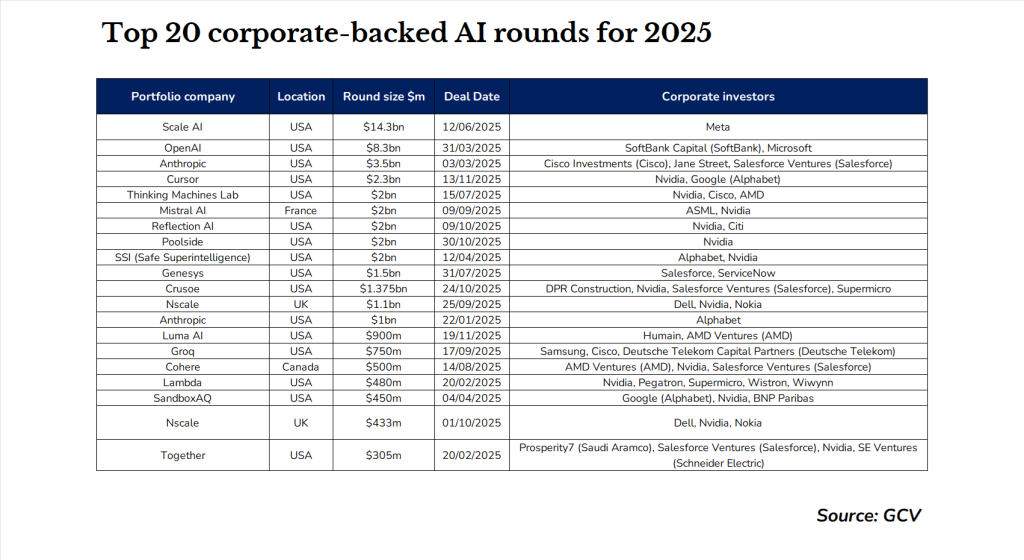
Not all corporate investors, however, are willing to chase every deal. Some are becoming more selective, wary of valuations that appear detached from commercial reality.
“Where I see an overvaluation is in software and, to some extent, in hardware,” says Yvonne Lutsch, investment director of Lam Capital, the CVC arm of Lam Research, a supplier of semiconductor processing equipment. “I tend to believe that for many companies that can still pay off. But in the software space, the valuations of some of these companies are really, really high. And, if hardware companies’ valuations in the early stage are above $500m, I am naturally sceptical.”
The scale of potential losses also worries some investors. Compared with previous technology cycles, far more capital is now at risk. A correction, if it comes, could therefore be more painful. “The amount of money that can go to zero overnight is much more. If the market correction appears, the higher the losses will be and the impact will be very big,” notes Lutsch.
Even so, the AI boom has made it possible for founders with strong reputations to raise eye-watering sums before producing a commercial product. The $2bn seed round raised last year by former OpenAI chief technology officer Mira Murati for her new venture is a case in point.
That dynamic leaves many corporate investors watching from the sidelines as the largest deals close.
Avoiding the hype
However, there are still some AI startups that are not overvalued and that can demonstrate revenues from an existing product, says Lutsch.
“There are AI companies that have built something, they have some revenue, and their valuation is not based on their name or their reputation. Their valuation is based on the near-term revenue they can bring. These companies are valued like “normal” startups and that is a good space to invest in. We are participating in the AI growth not the hype,” she says.
Lam Capital’s parent company has benefited from the AI rush as it is a supplier to the semiconductor sector building out infrastructure to power the technology. The CVC invests in semiconductor subsectors, AI chips and industry 4.0 technologies.
“As a corporate VC we act according to our company culture – humble and nimble. We don’t see ourselves in the role of spending billions investing in startups. But we still want to invest in the AI space, and also in software that enables us to build better products and to make our company more efficient,” says Lutsch.
Lam Capital’s AI investments include eBots, a maker of robots that can automate labour-intensive manufacturing, and Corvic, a generative AI enterprise intelligence software.
Others see early signs that the market is already cooling. Sean Wright of JLL Spark Global Ventures notes that some AI companies are now struggling to raise money on the terms they expected.
“Some valuations are coming down. Some AI companies are not necessarily getting funded or are not getting funded at the terms that they thought they would get,” said Wright at the GCV Connect: Germany event in October.
Most technology booms end with a large number of companies going out of business and the eventual emergence of a smaller group of durable winners, which can become enormously valuable. For corporate investors, the challenge is to distinguish between the two.
“We look for situations where there is a real value for us, where we can see it with our expertise, where we can see it apply to our corporate or to our clients, and where we feel that we have a better understanding, because we can tangibly see the value and how that’s going to materialise,” said Wright.
Recent AI investments that the JLL Spark team have made include Jeeva AI, an agentic AI software that generates sales leads; Acelab, an AI-powered platform to manage workflows in the construction sector; and Qbiq, a software that automates architectural planning.
A lot of innovation is still to emerge to power the AI revolution and CVCs have a unique role to play in de-risking that technology, says Nicolas Sauvage, president of TDK Ventures, the VC arm of Japanese electronics manufacturer TDK.
Innovations in energy generation and storage, transmission, computing and connectivity will all be necessary to create a sustainable way of deploying AI. “There is a huge amount of innovation that we can expect,” Sauvage told GCV. “I don’t think this is a bubble in terms of the level of innovations we are going to see in the next few years.”