Corporate venturers should view startup investments as weapons for fighting against competitors, says José Antonio Pascual, former head of Cencosud Ventures, in this op-ed.

For years, corporate venturing was sold as the antidote to obsolescence: a way to modernise aging corporate cultures. But at some point, that narrative starts to fall short. When the organisation has already learned how to “collaborate with startups,” run pilots, and host demo days, the conversation stagnates.
Both the corporate and startup perceptions of how corporate venture capital (CVC) units operate are outdated — or at least, incomplete. This explains why we’re seeing more CVCs shutting down, spinning out, or simply failing to launch new units fast enough.
Bringing the ‘startup mindset’ is not enough. CVC needs a more radical motivation in order to stay relevant as a tool for the future of our corporations. Every boardroom knows that there are only two ways to succeed in business – either you grow or your competitors shrink. But almost no one is talking about how to weaponise CVC to make others retreat.
The question that changed everything
A few years ago, one of my mentors — the CEO of a publicly listed company — asked me a deceptively simple question during a conversation about startup–corporate partnerships:
“How can they fight for us?”
I froze for a few seconds, trying to make sense of what he meant.
“What do you mean?” I asked.
He looked at me and said:
“Yes — how can we leverage their technology so that our competitors retreat, or at least weaken?”
That conversation stayed with me for months. At first, I didn’t even know how to digest it. Everything I had done until then — as a corporate innovator in any role — revolved around collaboration: building resilience, improving processes, fostering new business models, or finding mutual gains between corporations and startups. The kind of motivations we’re all taught to pursue in corporate venturing.
But, the answer to my mentor’s question needed to be different. It wasn’t about collaboration. It was about forcing others to retreat from something we wanted.
It sounded like military language.
It sounded like war.
From innovation playbooks to war theory
To make sense of it, I read and listened to many podcasts and videos about war theory — and there was a name that kept repeating: Carl von Clausewitz, the Prussian general who reverse-engineered Napoleon’s success in the early 1800s. It was Clausewitz who famously said war was “the continuation of policy by other means., his philosophy around war still relevant in every military academy worldwide.
(You can find his book On War [here], listen to this Google Talk, or explore this podcast about his life and influence.)
The same war principles can apply to a business setting. When traditional corporate mechanisms—from modifying pricing and increasing marketing to developing an incremental business line — no longer move the needle, your corporation needs to start thinking out of the box, and fast. Sometimes that might mean building new ways or partnering with third parties that have uncertain technologies. That’s when venturing becomes an extension channel of action.
Corporate venturing is the continuation of strategy by other means. It is often talked about in positive terms, of collaboration and partnership. But what if the real power of corporate venturing lies not in being a better corporate but in making your competitors worse? What if startups could be weaponised to force your competitors to reposition or retreat, therefore, shaping the market in your favour?
That’s what I call “dark venturing”: developing tactics and exploits — leveraged through third party dynamics—that target your competitors where they are vulnerable.
One of the patterns in strategic warfare — military or corporate — is that offensive tactics, once successful, eventually solidify into defensive standards. What begins as a way to disrupt competitors often evolves into a new baseline that everyone must meet just to stay in the game.

Take the case of customer loyalty programs and the disruption of Amazon’s Prime.
Amazon’s early experimentation with Prime in 2005 was a clear offensive manoeuvre against the ecommerce status quo — a bold attempt to deliver a superior value proposition, activate demand, and reshape user behaviour.
It was a bet on acquisition through convenience and benefits, designed to build a moat, reduce churn, and siphon demand from slower, less integrated platforms. They were poaching customers at scale. The financial uncertainty was significant — few understood how capital-intensive the model would be. But it worked. This triggered a chain reaction across industries.
From retailers to airlines, from banks to subscription services, “Prime programs” became the new normal. It stopped being a differentiator and, in many cases, became a requirement for survival.
Why every theory regarding corporate venturing is really about defence
At the highest level, when a company launches a corporate venturing unit, it is ultimately driven by a deep need for strategic adaptation. Behind the usual narratives of innovation, partnerships, or disruption, most initiatives can be distilled into two fundamental objectives:
- Strategic learning and capability building
Corporations know their current business models won’t guarantee future relevance. Venturing becomes a way to see what they don’t yet know—to spot emerging trends, engage with new technologies, and build capabilities they currently lack, all without risking the core business. - Organisational adaptation and transformation
Working with startups applies external pressure that challenges internal culture, processes, and structures. That pressure is precisely what drives internal transformation—forcing faster decision-making, new governance models, and more agile ways of working that would be difficult to initiate internally. Current corporate venturing theories and practices are primarily about organisational relearning—about changing your company and making it more defensible—against current and future market dynamics.
But current open innovation and corporate venturing frameworks don’t teach you how to attack a competitor directly. What if the conversation between a business manager and the venture unit was: “We need submarines that can torpedo this particular customer segment, poaching them from our competitors.” (This request was paraphrased almost word-for-word from a real conversation I had with a manager.) How would current innovation theory help us respond? None of it talks in terms of attack.
Why nobody is talking about attack
There are three reasons for this. As Ben Horowitz points out, the modern MBA is trained to be a Peacetime CEO — someone who manages growth, optimises operations, and plays by established rules. Business schools reward clarity, consensus, and best practices. The vast majority of strategic frameworks taught in these environments are designed to defend positions, not to challenge them.
Second, there is the cultural discomfort with aggression itself. As Peter Thiel provocatively said: “The hippies won.” The philosophical undercurrent of today’s business world favours peace, ecosystems, co-creation, and collaboration. While these terms may sound progressive, they often obscure the underlying reality: that markets are still competitive, that resources are finite, and that advantage is not shared — it is won.
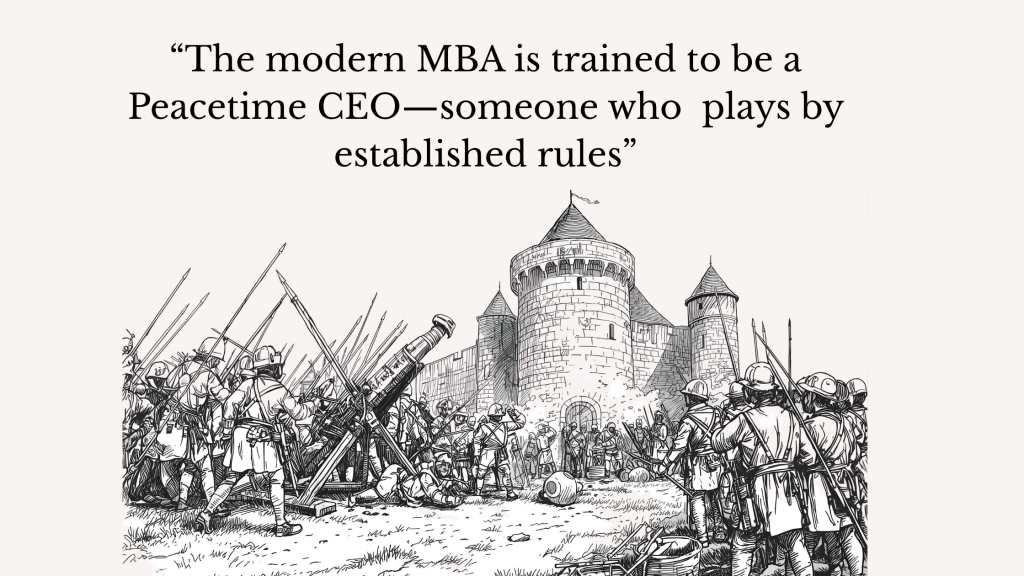
Lastly, there is a lack of intellectual diversity in corporate teams. Unlike fields like the military or national security—where leaders are trained in deception, momentum, and asymmetric warfare—corporations overwhelmingly favour finance-driven profiles, optimised for control, predictability, and efficiency.
Veterans or strategists with backgrounds in defence or intelligence are rarely considered, despite their expertise in dynamic, high-stakes environments. Instead, innovation teams are typically staffed with ex-consultants and process managers — experts at optimisation, but not at strategic offence.
They measure. They report. But they don’t manoeuvre.
These three forces—education, culture and organisational design —have converged to make “attack” a forgotten concept in the corporate agenda. Not because it’s obsolete but because we’ve trained ourselves not to see it.
Developing a dark venturing mindset: Examples of attacks
1. Understanding and hitting our competitor’s centre of gravity:
The first time we executed an attack strategy — albeit unintentionally — was through a partnership with an innovative last-mile provider. At the time, my former employer led the grocery ecommerce space in Southern Hispanic America, at least a year ahead of competitors. Our initial goal was simple: lower delivery costs by working with a more efficient, tech-driven player. But as we increased the last miler’s share across our operation, other providers began losing volume — and raised their prices to our competitors in response, to avoid bankruptcy.
After almost one month of starting the rollout, the country’s largest last-miler called me directly, asking us to slow down the rollout — begging me to stop decreasing prices. In return, he offered a significant minority stake in his own company. Intelligence later confirmed our assumption: our consolidation strategy had created a pricing imbalance that gave us a clear edge.
I proposed going further — giving the last miler full control of our ecommerce deliveries and locking in mutual exclusivity. The goal: collapse the competition’s ecommerce by imploding their last milers and buy us time to expand before they recovered.
The idea was ultimately rejected by the top management. The committee was unwilling to rely entirely on one provider. But the insight remained: we had found our competitor’s ecommerce centre of gravity — we could hit their operation directly and force a retreat before they even understood what had happened.
2. Rearguard attacks: Locking in valuable customers from competitors—through a different narrative
In the grocery sector, food waste has always been a critical issue — and increasingly a reputational one. Every player wants to be seen addressing it. That’s why we began piloting with a range of startups offering innovative solutions to this challenge.
One of the most promising was Cheaf, a company from Mexico with a model similar to European platforms like Too Good To Go. People can buy a surprise bag of food at a great price through this app, allowing the retailer to avoid waste.

The potential seemed great: strong demographics, high engagement, and overwhelming customer satisfaction within the first month. But we found something even more interesting: The vast majority of users came from our hardcore direct competitors, and they kept coming back — not just for the surprise bags, but for additional purchases. In testimonial interviews, many openly shared that they had abandoned their previous grocery store and shifted their loyalty to us.
Although Cheaf operated as an independent food rescue platform, it functioned as a strategic bridge: it attracted price-sensitive consumers who weren’t loyal to our brand and redirected them — through a powerful ESG narrative and preferential access — into our retail ecosystem.
What started as a sustainability initiative turned into an aggressive rearguard attack. We began poaching thousands of competitor customers at scale — quietly, consistently and profitably.
3. The fog of war: Investing without saying it
Although this strategy was controversial, it initially created a fog of war scenario—our competitors suspected, but were never certain, that we had invested in certain highly differentiated startups. As a result, they were reluctant to engage with those companies, assuming that any collaboration would ultimately benefit us, even though we only held minority stakes.
From the intelligence I gathered, at least one competitor actively avoided working with any startup they thought we were in conversations with — unsure whether we had already invested, or were about to.
When I shared this with our general managers, they smiled. We had secured informal exclusivity without ever asking for it, and effectively blocked our competitors from accessing innovation that could have strengthened them.
This strategy didn’t limit our portfolio companies’ growth — the footprint of our business gave them plenty of scope for expansion and, eventually, they did start conversations with our competitors as well. However, the tactic gave us a two-year strategic head start — and in venturing, that’s often all you need.
Putting a dark venturing strategy into practice
At first, we didn’t disclose the full intent to the startups involved — but eventually, we began sharing it openly. In most cases, founders responded with curiosity, alignment, and even enthusiasm.
That said, most of these strategies were never approved internally. There were two main reasons: first, while we were moving full speed with attack strategy design over the past two years, the company was simultaneously undergoing profound governance changes — making long-term decision-making difficult.
Second, it was often hard to justify how an attack-oriented model could align with financial sustainability. Whenever top management had to prioritise based on projected impact, attack initiatives typically showed lower EBITDA contribution — at least on paper — compared to more conventional, business-as-usual projects.
Even if forcing a competitor to retreat clearly opens market space and should impact your profit and loss account positively, attribution is messy. It’s difficult to prove that your initiative directly caused that market shift.
Still, we managed to execute several attack strategies with solid financial logic behind them. Some of them scaled rapidly, exceeding our initial projections several times over. But the truth is, there are many more initiatives that could be launched purely to break even—yet strategically target and weaken a competitor.
Despite these limitations, we experimented with a wide range of ideas to better understand what frameworks, patterns, and outcomes actually worked.
In my view, dark venturing, meaning designing and executing both defence and attack strategies, follows the same logic as any venture-driven portfolio: it’s not about doing just one or two bets—it’s about trying many, developing the muscle and doubling down on the ones that create real disruption on your competitor’s lines. As in war, the resources allocated to defence are significantly larger and more predictable than those dedicated to attack, but you still need some attack muscle if you want to gain market share.
Once you develop a dark venturing mindset, you can’t unsee it. It reshapes how you view strategy, innovation, and even the role of startups. It challenges everything we learned from traditional CVC —making it far more controversial but also far more potent.
José Antonio Pascual is a corporate venturing practitioner. He is the former head of Cencosud Ventures – a South American retailer – and former investment manager at Wayra Telefónica in Hispanic America.