From tracking success stories to helping corporations get comfortable with risk, here are ways that CVCs can explain their relevance.

Corporate investment in startups is about seeing into the future — getting insight into where an industry is going and helping a big business navigate technological transformation. It is as much — or more — about this strategic guidance than it is about any financial return.
“The wins are for us are our head of IT saying: ‘You know, five years you guys were talking about generative AI, and I really appreciated the heads up’,” says Dave Stevenson, managing director at MSD Global Health Innovation Fund, the investment arm of the US pharmaceuticals company MSD. “That’s where you know they value you as a partner, that they seek you out for your advice, and that you provide something that consultancies or industry publications can’t.”
Being seen as a trusted adviser by the US healthcare company has meant MSD GHI is on its fifteenth year as a corporate venture fund, in an industry where many such units are closed after only three or four years.
In a similar way, In-Q-Tel, a fund that invests in startups on behalf of US intelligence agencies including the CIA, plays a role in keeping the government up to date on the latest technology developments.
“There’s insights on where technology is headed, making sure our government partners stay current,” says Dave Lobosco, chief technology architect at In-Q-Tel. “Both from them to be able to leverage it, but also if there are threats or risks for national security from how the technology is being used globally.”
Carrying out this role as futurist and strategic advisor, however, requires a little-appreciated skill: storytelling. Corporate investors must be able to paint a picture about the future for corporate stakeholders in a way that hits home and inspires action.
There isn’t one right way to do this. It may require a variety of tools and some experimentation to find the ones that work best for a particular company.
“If you have a thesis that you trying to convey to your corporate sponsor, different ways [of telling that story] resonate better than others. I think having a variety of options help move the ball forward,” says Lobosco.
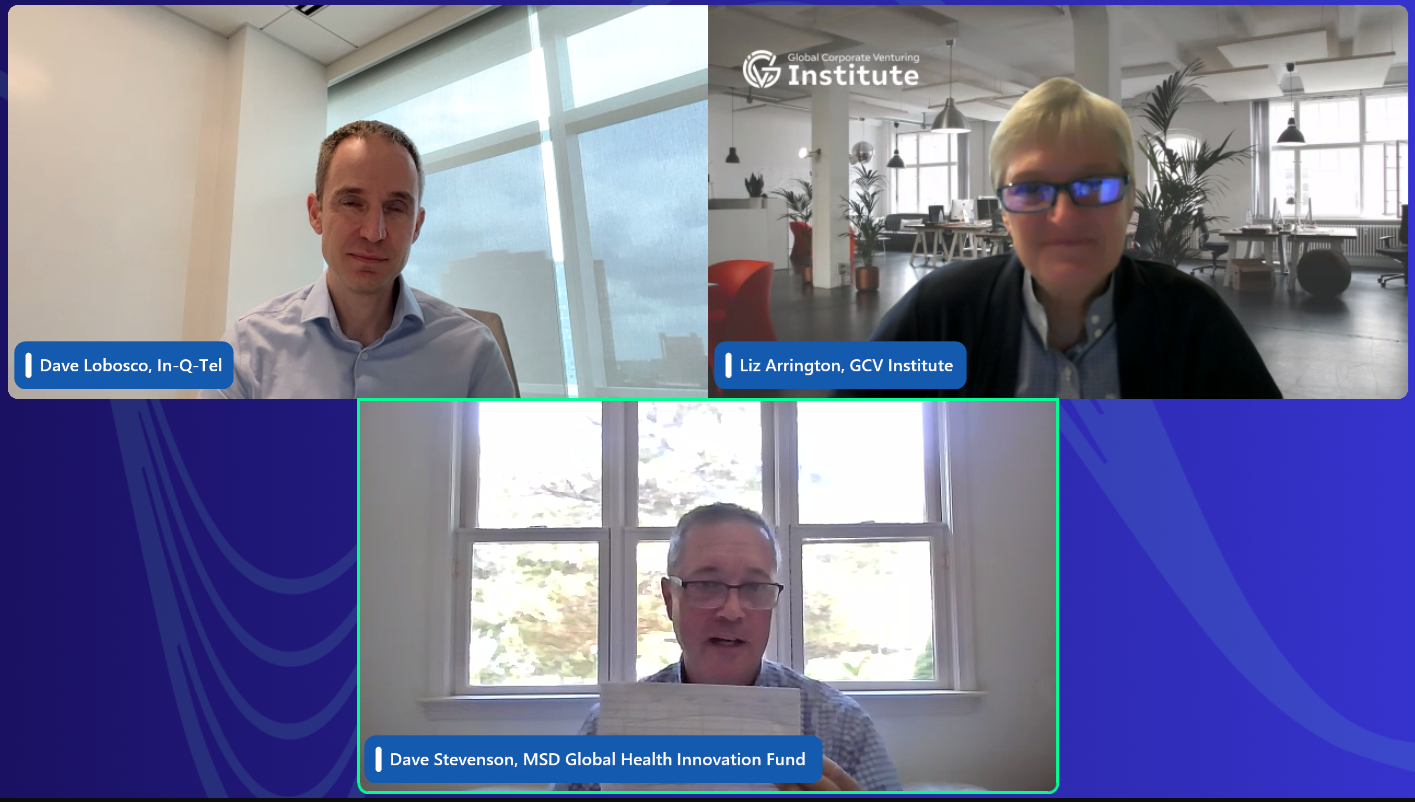
Stevenson and Lobosco shared some of their storytelling tips and learnings in a recent webinar, Communicating CVC strategic performance through insights. Here are some of the things we learned.
1. Start with writing briefing notes and white papers
“Fifteen years ago, we were writing a lot of white papers,” says Stevenson. In the beginning the MSD GHI team spent a lot of time educating the healthcare company about new trends such as edge computing and mobility that would impact key areas, such as the way vaccines would be transported. “You are trying to look forward and say here’s where the demand is going to lead.”
Fifteen years on, the team has invested in several companies doing the things it described in these white papers. There is less focus on writing now, but those initial papers laid the groundwork.
At In-Q-Tel, the production of white papers and briefing notes continues — at an almost industrial scale.
“We talk to about 1000 companies a year. We publish a meeting note on every one of those conversations, which is the beginning of the insights process,” says Lobosco. “We have a kind of a more formal insights team that’s embedded with the rest of our team, working with the technologists, the investment team, to help us think through how you would explain this to a non-technical expert.”
The team creates a wide variety of material, both for internal and external consumption. “It’s a mix of blog posts, podcasts and deeper, longer articles that either get published on our website or in different publications that we’ve linked to,” says Lobosco. “It’s a way to make sure we have a voice in the public conversation around technology.”
The team also writes between five and 10 longer research papers — what it calls global competitive analysis projects — every year.
“It’s a deep dive in a certain topic area, whether it’s one aspect of AI or cybersecurity or autonomous vehicles. We talk to dozens of companies in the space and other investors kind of pull those perspectives together and weave it through a presentation that we share with our partners. Those are pretty significant efforts,” says Lobosco. “It serves two functions. Part of it’s the insight and awareness for both our firm and partners, but it also helps drive our investment strategy. It educates us on making sure we know the market and can pick the best potential investments.”
2. Track everything — but remember to explain the “why”
In addition to painting a picture of the future, investors also need to tell corporate leaders stories about the impact and success of their work.
Here, it is important to collect many metrics: How many portfolio companies have engaged commercially with the parent company? How much money or time was saved as a result of these collaborations? What additional revenues did they bring?
“We track everything. We have a lot of metrics,” says Stevenson. “We really try and tie it back to motherhood and apple pie stuff for the pharmaceutical industry. They want to find patients. They want to find better molecules. They want to find ways to be cost efficient in how they deliver those products. Everything we do ties back to those very high level themes.”
But Stevenson says statistics on their own mean nothing without anecdotes. Saying that a particular startup partnership brought another 100 patients into a clinical trial is not in itself enough, he says. Taking the analysis a step further to say that the trial was accelerated by six months as a result is what people will remember.
“I’m not saying don’t track stuff. But it won’t hold water if there’s not that anecdote to say why it is important.”
Lobosco agrees. “We track how many companies we’re talking to, how many investments we do each year. Does the government actually try out the enhanced product that’s delivered? Do they adopt it, want to use it operation, or buy more of it?” But, he says, one qualitative story about a successful collaboration may have the most impact.
“At the end of the day one impactful story might outweigh 100 times something that is read,” he says.
3. In-person meetings are the most powerful communications tool
The good thing about written material is that it can be distributed widely and people can consume it at their own pace, says Lobosco. But in-person meetings are the most powerful way of getting the message across.
“We do a lot of meetings. We host roundtable discussions, we will host different kinds of convening events where we do a deep dive in a certain topic, and have leaders in a certain technology area give briefings and have that interchange with our government partners,” he says.
“We love to have those be in-person discussions just because the conversation yields so many more insights, for lack of a better word, that, you know, the questions might lead us down a different path.”
Stevenson says his team — much smaller than In-Q-Tel’s resources — often acts almost like consultants, going in to sound out key internal leaders.
“We routinely meet with the business. We spend a lot of time bringing our views in but then also listening to what they have to say,” he says.
One of the key things, he says, is “knowing your audience, knowing what are their fears, what are their limitations, what are the hurdles? How’s the best way to communicate them?”
4. Storytelling is about helping a corporation get comfortable with risk
One of the jobs of a CVC leader is to shift “herd mentality” that exists in corporations, says Stevenson.
“We all work in big corporations, and for the most part, most people in big corporations are not huge risk takers. Anything you can do to communicate around de-risking an investment is critical,” he says.
MSD GHI often co-invests in startups with other peers in the pharmaceuticals sector. This can be key to communicate back to the parent, as interest from other companies validates the startup and makes MSD executives more relaxed about the risk.
Sometimes the CVC unit will also pay all or part of the cost of running a pilot project with a startup to demonstrate that it works. These de-risking exercises should form a critical part of the communication strategy.

5. Make business the hero in success stories
Every CVC team loves to tell success stories about how their portfolio companies have helped the parent business. These are the stories that win over sceptical C-suite leaders.
When telling such stories, says Stevenson, it is important to cast the business leaders, rather than the CVC unit, as the hero. The story should about a courageous business unit leader engaging with a new technology, not about the CVC unit’s role in making this happen.
“No story that gets released within MSD is about how GHI leads. You have the business leader talking about why it’s important. It creates much more demand from those other vice presidents who maybe were a little standoffish to start with.”
6. You will know you are doing it right when people start calling you
A good storytelling strategy may take some trial and error to hone. A sign that it is working is when business managers start proactively engaging with the CVC unit.
“At end of the day, if they pick up the phone or return your emails, you know you’re doing a good job,” says Stevenson. “They vote with their feet. If they’re not responding or can’t find the time for you, generally, that is a sign that things aren’t amazing.”
Watch the full webinar below:
This webinar is part of GCV’s The Next Wave series of webinars. We run a webinar every month, alternating between advice for CVC practitioners and deep dives into specific investment areas. The Next Wave webinar, on September 10, will focus on how corporate investors can handle secondary market sales of startup holdings. Register your interest here to secure a place.

Maija Palmer
Maija Palmer is editor of Global Venturing and puts together the weekly email newsletter (sign up here for free).