ETH Zürich spinout company Haelixa has developed a technology that uses DNA to mark raw materials and finished products as a way to verify their authenticity with uses in textiles, the diamond sector and food.
US retailers Walmart, Target and Bed Bath & Beyond found how costly it can be to sell mislabelled products when they faced a lawsuit several years ago for falsely labelling linens as “100% Egyptian cotton” when they were actually sourced from an Indian textile manufacturer.
Egyptian cotton sells for a premium because it is more durable and higher quality. Consumers complained they overpaid for a product falsely labelled something it wasn’t.
The fallout from such scandals costs brands millions of dollars to put right, not to mention the harm to their reputations. But a new technology that uses DNA to mark and verify the origin of a product means big brands can prove their goods are what they claim to be, potentially saving millions in costs.
Founded in 2016 as a spinout from Swiss university ETH Zürich, Haelixa has patented a plant-based DNA marking technology that can be applied in liquid form to raw materials early in the supply chain. The DNA, once applied, cannot be removed even though the materials, in the case of textiles, go through several cycles of washing, bleaching and dyeing. The DNA marking is invisible and non-toxic.
The DNA markers can be traced using PCR tests, made widely available during the Covid pandemic.
The technology was invented by Gediminas Mikutis, who cofounded the company while studying for a PhD at ETH Zürich. He was inspired to invent a traceability solution after a trip to Vietnam where he bought a pair of brand-name running shoes. The next day the shoes fell apart, suggesting they were fake.
Back at the university, he came up with the idea of using DNA to trace a raw material that would verify its origin. He found that the DNA, which is derived from plants, is cheap, robust and durable and can withstand harsh processing.
“Once you apply something at the early stage on the fibre, you don’t want the DNA to get destroyed. And this is what we managed,” says Patrick Strumpf, chief executive. “Once we managed to solve that problem, we saw that we can use DNA not only in textiles. We can use it on many different segments and different industries.”
Clothing retailers that have endorsed the company include Hugo Boss, C&A and OVS.
The technology can be used to verify parts of the textile industry supply chain such as the sourcing of organic cotton. Organic cotton is more sustainable than virgin standard cotton as less water is used in its production, but it is also 20% more expensive. Because of the higher costs, it is sometimes blended with virgin standard cotton to lower production costs but then sold to clothing brands at a higher price.
This creates problems for brands that want to label products accurately and it also means retailers are paying more for cotton that isn’t actually 100% organic. Thirty percent of cotton that is labelled organic is thought to be virgin standard cotton.
Cost savings
“We are helping the brand get what they paid for. And that is something we found is way stronger than saying we are supporting them with sustainability. Sustainable sourcing is a hard sell. But we found this commercial value when we could say, you are spending 20% more for something that in the end you are not getting,” says Strumpf.
In the clothing sector, Haelixa’s customers tend to be textile manufacturers, often based in Asia, rather than the retail brands. This is because clothing brands tend to push costs of tracing to their suppliers.
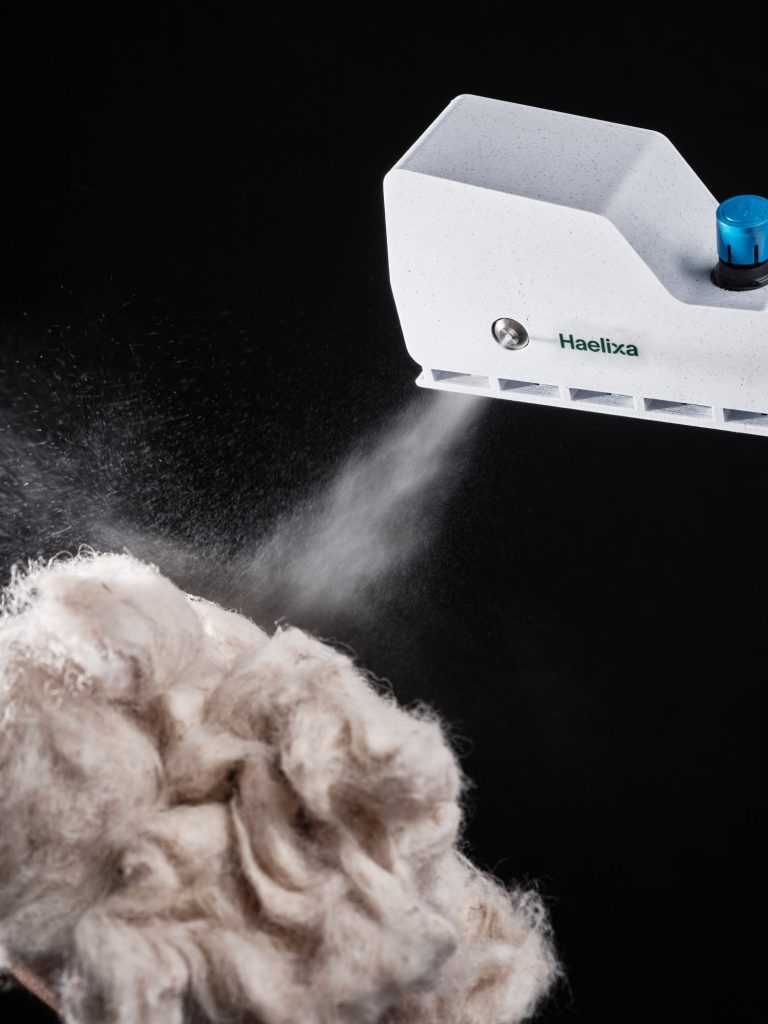
The DNA can be integrated into existing textile manufacturing processes through a sprayer device, which can be controlled and monitored remotely by the company. This way it can see how much DNA has been used and also allows it to spot if the raw material has been blended.
The company has since branched out to using the DNA to mark products in other sectors. It has had interest from the diamond industry, for example. The team were approached by a blockchain company that gives out certificates for the ownership of diamonds. The company needed a way to verify the origin of the physical assets to prove, for example, that they were not sourced from illicit mines used to fund military action against governments.
Haelixa bathes the gemstones in a DNA liquid. After the liquid evaporates, the DNA remains on the surface. Once the diamond is cut and processed, an additional DNA marker can be applied that is specific to a brand name such as De Beers or Cartier.
In February 2026 Haelixa raised €2m ($2.4m) in a pre-series A. The round was led by existing backers Verve Ventures and Zurich Kantonalbank, with participation from impact investor 212 NexT Fund.
The company will use the money to expand internationally as well as expand into anti-counterfeiting. It plans to work with luxury goods companies, for example, to create distinct markers associated with particular brands for finished products.
Its technology could also be applied to other industries such as food. It could, for example, trace the origin of coffee to verify that it is not sourced from an area of deforestation. This same idea could be applied to premium foods such as honey, saffron and vanilla.
Although the company has financial VC investors, it would consider taking on corporate VC backers. Strumpf says corporates in the testing sector could be good partners because of their customer networks. The technology also has traceability potential in rare earth metals, cosmetics, pharmaceuticals and forestry.
See recent corporate-backed traceability startup deals the CVC Funding Round Database