The company has partnered with 300 startups and plans to do more as part of its newly spun off VC.
India’s largest producer of aluminium, zinc and copper is ploughing most of its money into venture clienting partnerships after its VC investment arm spun off from the mining parent.
The new corporate venture unit, V-Spark DeepTech Ventures, has a budget of between $40m and $55m for venture clienting. It plans to invest between $12m and $15m in startups.
Vedanta spun off its CVC in December last year after finding it difficult to gain approval for investments. As a publicly listed company in India with a large government shareholder, getting investments signed off was “painful”, says Amitesh Sinha, CEO of V-Spark DeepTech Ventures. “We are still part of the parent in many ways but being a separate entity gives us a lot of freedom,” he says.
For the three-and-a-half years before it was spun off, the unit had found success with a venture clienting model, where it works with startups on a commercial basis rather than taking minority equity stakes. Of the 300 venture clienting partnerships it had with startups, between 60 and 70 provided financial returns by either increasing throughput or reducing cost.
“For every $1 put into the ecosystem of venture clienting, we got $4 back in three-and-a-half years,” says Sinha.
More corporates globally are turning to venture clienting as a quick and efficient way of bringing startup technologies into their businesses. Nearly half (49%) of corporate venturing teams said they engage in venture clienting, according to GCV’s Keystone survey, up from 47% the year before.
“For every $1 put into the ecosystem of venture clienting, we got $4 back in three-and-a-half years.”
Amitesh Sinha, CEO of V-Spark DeepTech Ventures
Starting with a venture clienting model has also helped the ventures team to evaluate startups for taking equity stakes, he says. “Once you start doing these projects, we not only evaluate them from a financial standpoint, we look at the team, the product and we spend a lot of time with them, so it helps us filter out these startups for investment.”
About 5% of the startups that started as venture clienting partnerships became investments. The newly independent CVC plans to invest in between five and seven startups this year.
The venture unit also plans to build or co-create ventures down the line. Acquisitions are also part of its plan.
Parent company Vedanta, which is headquartered in London, UK, has a diversified portfolio of assets. It is the largest mining and non-ferrous metals company in India, with operations in Australia, Africa and the Middle East. Its products include lead, silver, oil and gas, iron ore and power.
The venture unit’s targeted investments include technologies that improve the success of oil and gas and critical minerals exploration, such as drone tech and space technologies that use hyperspectral imaging.
It is also looking into technologies that would allow it to extract more minerals from its mines, as well as advanced materials that offer an alternative to rare earth metals. The company has an agreement with a startup to research the use of zinc in batteries, for example.
The venture team will also look at future business lines for the mining parent. One area it is considering is the semiconductor sector. In 2024, Vedanta announced a $500m investment in a semiconductor manufacturing facility through its subsidiary AvanStrate.
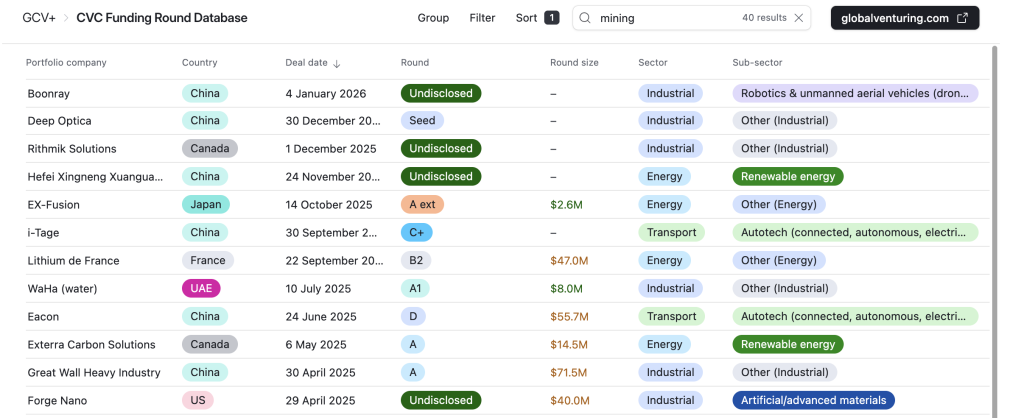
See all the recent mining-related startup funding rounds backed by corporations in The CVC Funding Round Database
It sources startup investments globally but has worked predominantly with Indian companies in venture clienting partnerships. India’s deep tech startup ecosystem is evolving, says Sinha, but the country still lacks patient capital needed for deep technologies.
The Indian government committed $1bn to a deep tech ventures fund last year, the India Deep Tech Investment Alliance, to bring more investment in Indian deep tech companies.
“It’s gradually improving, but for India to have that deep tech ecosystem will take some time, because it’s a lot of patient capital, which is slightly lacking in India right now.”