Investment in defence startups is increasing rapidly with many nations developing their own critical technology supply chains.
2025 was one of the busiest years on record for corporates investing in defence, surpassing the peak recorded during the VC investment boom of 2021. While the number of deals recorded in 2025 (143) was slightly lower than the previous year (153), the number of dollars invested by corporates in defence tech in 2025 was $5.9bn – a 28% increase from 2024 ($4.6bn).
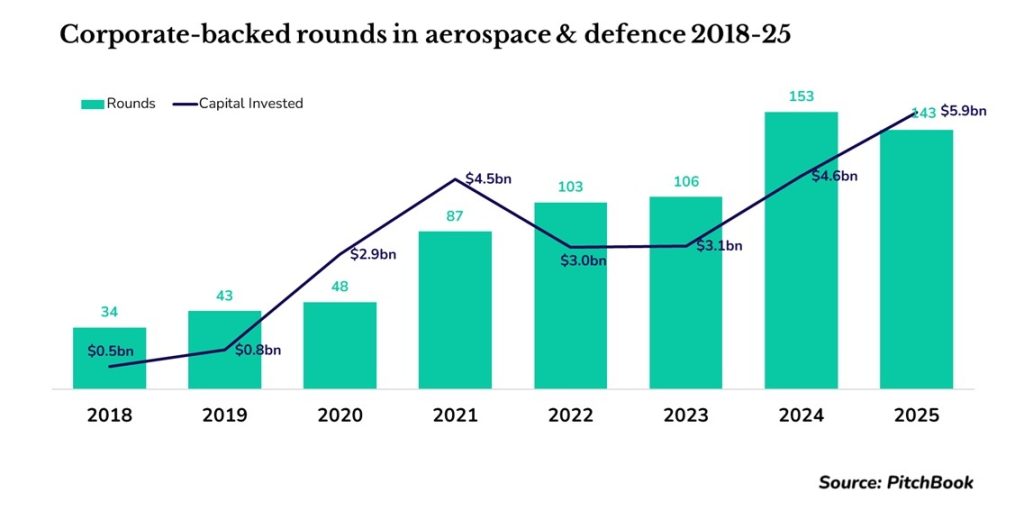
Investments in defence have only increased over the last few years, barring the drop in 2022 due to the pullback in corporate VC activity across all sectors. It’s likely that this will continue to be the case given the global geopolitical landscape that’s led to a deeper focus on defence and security investments.
Key trends for 2026
Conflicts such as Russia's invasion of Ukraine and Israel's invasion of Palestine have pushed nations across the board to boost their defence budgets to be at the forefront of new, cutting-edge technology. Developing self-sufficiency in military capabilities has become a key priority.
“Nations are recognising the strategic risk of outsourced supply chains and are moving quickly to develop and protect their own critical technologies to underpin national security.”
Nichola Bates, founder of XeleratedFifty
“Nations are recognising the strategic risk of outsourced supply chains and are moving quickly to develop and protect their own critical technologies to underpin national security," says Nichola Bates, founder of XeleratedFifty, the innovation and investment group that recently spun out of aerospace company Boeing.

Critical Intersections is an exclusive gathering bringing together a highly curated group of corporates, investors, startups, and government leaders shaping the future of dual-use technologies.
Held in Washington, DC, this intimate program focuses on how advanced energy systems, next-generation materials, AI, mobility, and resilient supply chains converge to drive defence readiness and strategic advantage.
Attendees can expect focused discussions with senior decision-makers, curated startup showcases highlighting investable and deployable technologies, and high-value networking in a setting built for one-on-one engagement.
Bates believes a key trend for 2026, as a result, will be the global shift toward building sovereign defence capability.
Another trend for 2026 will faster acquisition of new technology, says Alison Perez, senior investment and portfolio manager at Lockheed Martin Ventures, the CVC arm of US aerospace, arms, defence, information security and technology producer Lockheed Martin.
Nations are increasing their agility and flexibility in procuring new defence tech so that they can stay at the forefront in an increasingly competitive market. US-based defence manufacturer Booz Allen Hamilton was partly responding to this in mid-2025 when it increased the capital available for its CVC arm to $300m to invest and deliver the best tech possible at speed and scale.
The current US administration has redoubled its efforts to tap into innovative technology and direct more funding outside the traditional contractors. The scope of opportunities, therefore, is vast and the competition to gain an edge fierce.
“I believe this will lead to the appearance of a higher number of acquisition-ready platform companies and an emphasis for defense primes to partner with new entrants,” states Perez.
Kiichiro DeLuca, partner at Weru Investment, the VC arm of Japanese asset management company, on the other hand, believes in a more collaborative trend for the year ahead.
“I think we're seeing from late 2025 going into 2026, much more active cross-border defense tech startup activity. Some examples include Anduril setting up a much more visible and direct presence in Japan recently and South Korean Hanwha investing in and partnering with a US defense tech startup,” says DeLuca.
“As allied militaries are rapidly warming up to fielding emerging capabilities, domestic startup ecosystems may not have sufficient homegrown capabilities, meaning operational or near-operational capabilities will be pulled in from other allied countries.”
Risks to watch out for
The downside of defence-related startups getting more attention is that with increased visibility comes an increased risk of being attacked, says DeLuca. The fact that they are also relatively young can make them more susceptible, he adds.
“Adversaries will inevitably target these companies both in the cyber realm as well as other domains.
“While each country's departments of defence will work to make this new industrial base secured and resilient, the security risks/threats will be unlike what emerging companies face in other industries.”
Other challenges include overcoming bottlenecks that are part of early-stage innovation and scaling new technologies at the manufacturing stage.