In the latest edition of GCV Blueprint, editor Maija Palmer does a deep dive into some of the key takeaways from the GCV Symposium last week.

One of the messages in the opening sessions of the GCV Symposium in London was the CVC industry might be about to expand dramatically over the next decade. We already saw a record number of corporates making investments in startups last year, bucking the general trend for retreat in the rest of the VC sector. More corporations continue to set up investment arms, partly in response to government incentives to do so (e.g., in Japan), partly as a way to keep up with an increasing pace of technological disruption (e.g., software companies making AI bets) and also because some corporate investors are seeing big returns from portfolio company exits (think Alphabet and SpaceX).
So, could the number of corporate investors go from 3,000 today to 30,000 in the next 10 years? And what happens if it does?
One point that Nicolas Sauvage, president of TDK Ventures and chair of the GCV Advisory Board, makes repeatedly is that the industry will need to have clearer and better standards. CVC has already moved beyond being a cottage industry. At ten times the current size, it becomes dominant in the startup ecosystem. If there is bad practice in the industry, it will do a great deal of harm and potentially stymie a whole generation of startups.
Secondly, CVC will at that stage be far more globally diverse than it is today. CVC started as a Silicon Valley phenomenon and fanned out from there, but already we have seen the balance shift with more corporate-backed funding deals happening in Asia than in North America. As CVC spreads, the Silicon Valley model will also become less dominant. One of the most vibrant discussions at the GCV Symposium was at the session looking at CVC in emerging markets, and a clear message that emerged was simply copying the Silicon Valley VC model would not work in these complex and risky markets – they needed CVC as a connective tissue between local entrepreneurs and global markets.
CVC toolkits will become more varied. This goes hand in hand with geographic diversification. Sometimes a classic investor relationship doesn’t work in an emerging market where both the startup ecosystem and customer opportunities may be sparse. Corporations might need to be predominantly company builders in some cases, or mainly customers and logistics conduits in others.
We will see more collaborative co-investments between both companies and whole industries. Already we have seen joint funds such as the Oneworld Breakthrough Fund, where a group of the Oneworld airlines are investing jointly in a sustainable aviation fuel fund run by Bill Gates’ Breakthrough Energy Ventures. The OGCI, set up in 2014, is a similar idea for energy companies investing in climate change mitigation technologies. With many more CVCs on the playing field, organising into squads will become the norm rather than the exception. Done well this potentially unleashes much more concentrated firepower into leading startups. But badly managed joint funds run the risk of decision-making stagnating and investment momentum grinding to a halt.
An order of magnitude increase in CVC would also lead to the emergence of what we might call a “corporate innovation economy”. Corporate venture capital becomes less of an asset class and more of a network of connections that underpins economic growth. With it comes the creation of dozens of new roles in CVC that are only ideas today: ecosystem architects, AI partnership officers, strategic alliance designers, innovation diplomats.
Exciting times. We will continue to bring you briefings and insights from the GCV Symposium on the website all week, so do go to globalventuring.com to see the latest.
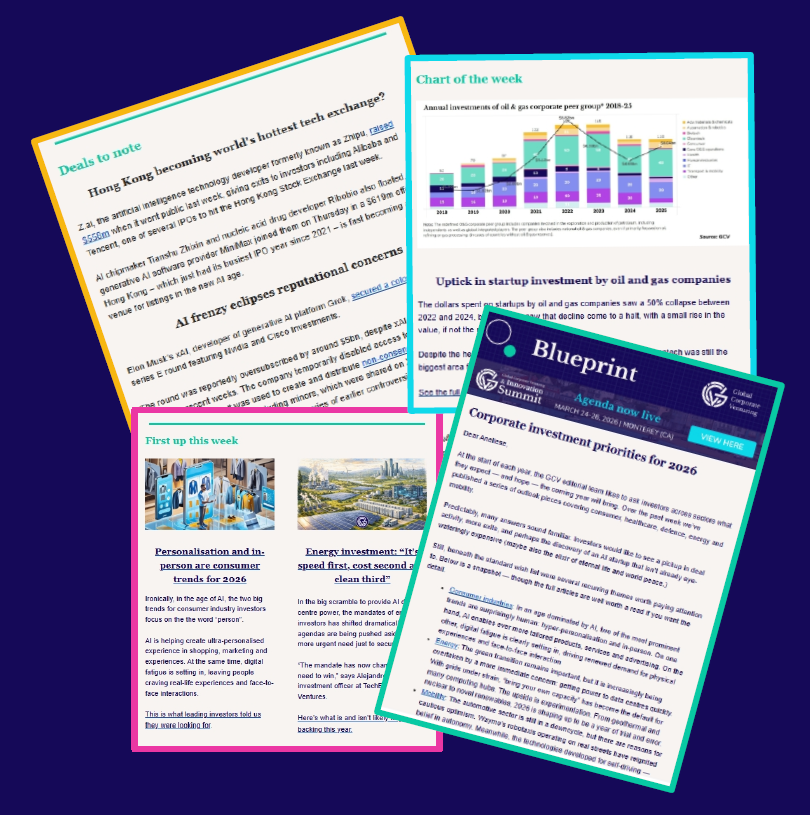
This editor’s note was first published in GCV’s Blueprint newsletter, which tracks corporate venture news, key deals, new funds best practice and jobs.
Want to get Blueprint directly in your inbox every Monday? Sign up for free here.

Maija Palmer
Maija Palmer is editor of Global Venturing and puts together the weekly email newsletter (sign up here for free).