AI is reshaping corporate venture investing, automating routine tasks while leaving judgement, relationships and strategy firmly in human hands.

Almost every conversation I have with a corporate venture investor these days invariably turns to AI, not as an investment theme but in terms of how they are using it to reshape their own venture investing workflows.
Over the past few weeks, the idea has surfaced in interview after interview. Sebastian Borek, managing director of Germany’s HTGF, describes using AI to identify potential matches between hundreds of startups and nearly 70 corporate partners. Other investors have spoken about AI-assisted sourcing, market mapping, technical due diligence and portfolio monitoring. Work that would previously have required the hire of several more associates is now within the reach of a smaller team.
What are the implications? CVC teams have always tended to be extremely lean so saving on hiring isn’t the point. Perhaps, though it will help put small corporate teams on more of a level pegging with the big VCs in ability to scan thousands of companies and monitor markets in real time. According to what we heard at an invitation-only AI roundtable during the GCVI Symposium, early experiments with AI scouting aren’t unearthing anything radically new or previously overlooked — AI tends to return safe, well-known options, rather than outliers. But this may develop in time, or at least, by handling the more routine elements, free human investors to find those dramatically underpriced gems.
The technology is moving quickly, but there is still remarkably little consensus on best practice, so GCV is developing a working group where CVC practitioners can share lessons and would love to get more of you involved. Contact Liz Arrington at the GCV Institute for more details on plans.
AI may also take corporate venture capital back to its roots. The hardest part of the job has never been identifying interesting startups, but convincing a business unit to pilot their technology, helping founders navigate a complex enterprise and earning the trust to become a long-term strategic partner. Those are deeply human skills.
CVC investors have always been connectors, orchestrators and bridge builders. AI can read the public performance metrics of a startup and suggest the introduction, but it cannot assess the character and staying power of the founder or build the trust between that entrepreneur and a sceptical corporate R&D team. It cannot navigate internal politics or spot the subtle strategic opportunities that emerge from a conversation over coffee.
So while it’s crucial to move fast in building AI tools to streamline CVC work, it has never been more important to understand the subtle skills that are distinguishing features of long-term CVC units. We’re uncovering many of these as we roll out our series of CVC Titans interviews with corporate venture investors with decade-long track records.
There is also growing emphasis on other elements of the investment toolkit, like venture building and venture clienting. We’re absolutely delighted to be hosting a webinar on venture building on August 19, featuring a high-powered panel including Jim Adler of Toyota Ventures, Axel Deniz of Bosch Business Innovations and Ralph Wilson, ventures lead at Arup, to discuss how venture building and venture investment intersect for maximum impact. Sign up here to secure a place (and get the session learnings and video replay sent to your inbox even if you can’t join us live).
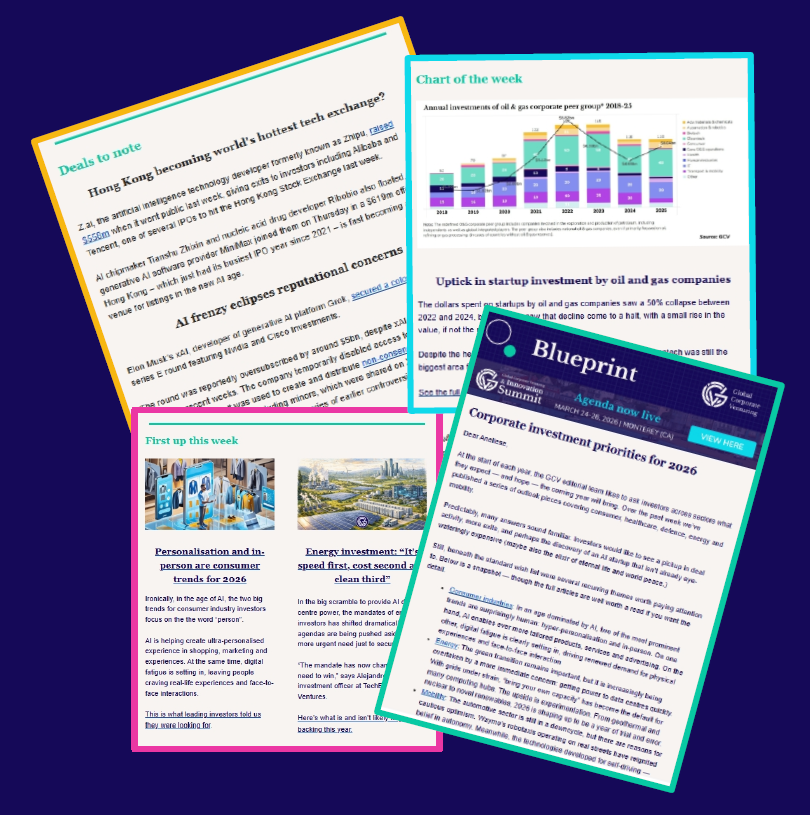
This editor’s note was first published in GCV’s Blueprint newsletter, which tracks corporate venture news, key deals, new funds best practice and jobs.
Want to get Blueprint directly in your inbox every Monday? Sign up for free here.

Maija Palmer
Maija Palmer is editor of Global Venturing and puts together the weekly email newsletter (sign up here for free).